الثلاثاء، 9 أكتوبر 2012

Economic Theory Implies Canadian Dollar will Fall

Sometimes I wonder if I’m living in the clouds. All of my recent reports on the Canadian dollar were twinged with pessimism, and I argued that it would only be a matter of time before reality caught up with theory. While the continued surge in commodities prices has confounded everyone’s expectations, other economic trends continue to work against Canada. In other words, I think that there is still a strong argument to be made for shorting the loonie.

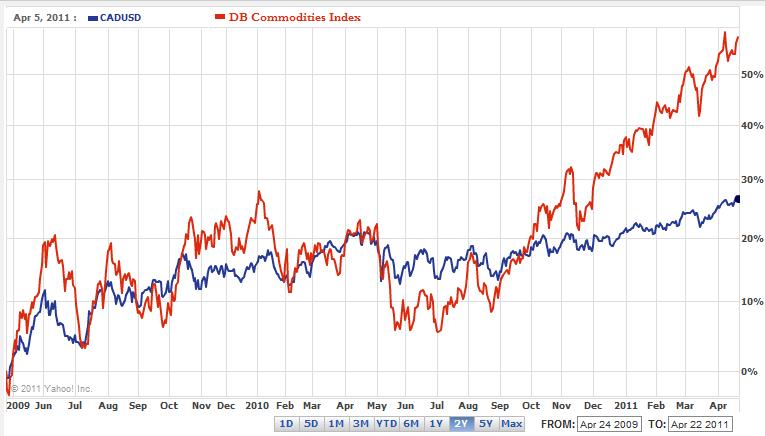
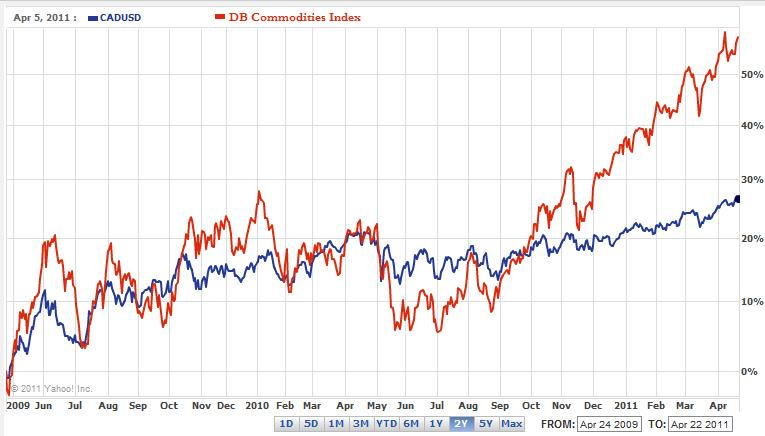
To be sure, the rally in commodities prices has been incredible- nearly 50% in less than a year! Oil prices are surging, gold prices just touched a record high, and a string of natural disasters have driven prices for agricultural staples to stratospheric levels. Given the perception of the Canadian dollar as a commodity currency, then, it’s no wonder that rising commodity prices have translated into a stronger currency.
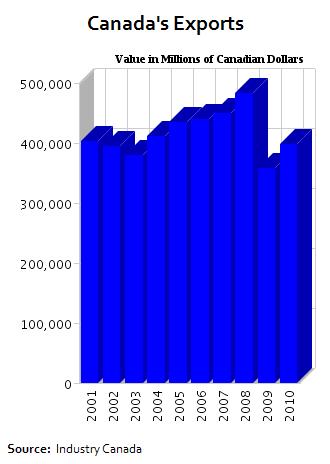
As I’ve argued previously, rising commodities prices are basically an irrelevant – or even distracting – factor when it comes to analyzing the loonie. That’s because, contrary to popular belief, commodities represent an almost negligible component of Canada’s economy. Canadian exports, of which commodities probably account for half, have recovered from the recession lows of 2009. On the other hand, the value of Canadian exports is basically the same as it was 10 years ago, when one US dollar could be exchanged for 1.5 Canadian dollars.
Consider also that Canada now imports more than it exports, and that the Canadian balance of trade recently dipped into deficit for the first time since records started being kept 40 years ago. Its current account has similarly plunged, as Canadians have had to finance this through loans and investment capital from abroad. Based on the expenditure approach to GDP, trade actually detracts from Canadian GDP. Any way you perform the calculations, commodities are hardly the backbone of its economy, account for about 15% at most.
As if that weren’t enough, the press is full of stories of Canadians that think their own currency is overvalued. Businesses complain that they can’t compete, and that banks won’t lend them the money they need to upgrade their facilities and become more efficient. Meanwhile consumers whine about higher prices in Canada, compared to the US. I think it’s very telling that there is now a 2-hour wait to cross the border from Vancouver, and shopping malls on the American side have reported a huge jump in business. Even the famous Big Mac Index shows that the price of a hamburger was already 12% higher in Canada back when the loonie was still hovering around parity with the US Dollar.
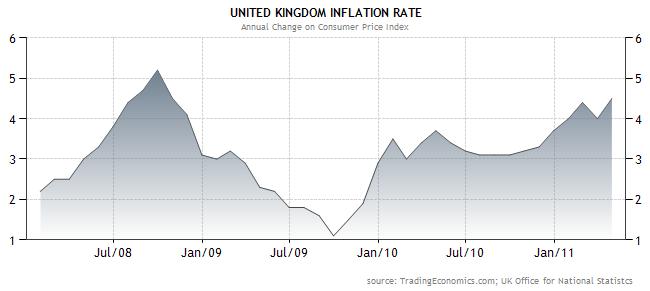
One area that higher commodities prices will be felt is inflation, which is nearing a two-year high and rising. At 3.3%, Canada’s CPI rate is now higher than in the EU. Given that the European Central Bank hiked rates earlier this month, it probably won’t be long before the Bank of Canada follows suit. In fact, forecasters expect the benchmark rate to rise by 50-75 basis points by the end of the year, from the current 1%.
This might excite carry traders, but probably few others. Besides, given that other central banks will probably raise rates concurrently, it can’t be assumed that carry traders will automatically gravitate towards the Canadian dollar. Not to mention that as I pointed out in my previous post, the carry trade is hardly a risk-free proposition. In this case, an interest rate differential of only 1-2% probably isn’t enough to compensate for the risk of a correction in the USD/CAD.
And that is exactly what I expect will happen. The fact that the loonie has shattered even the most optimistic forecasts is not cause for bullishness, but rather for concern. According to the most recent Commitment of Traders report, net long positions are reaching extreme levels, and it’s probably only a matter of time before the loonie returns to earth.

Read more

Currency Correlations, Part II: Canadian Dollar Begins its Decline

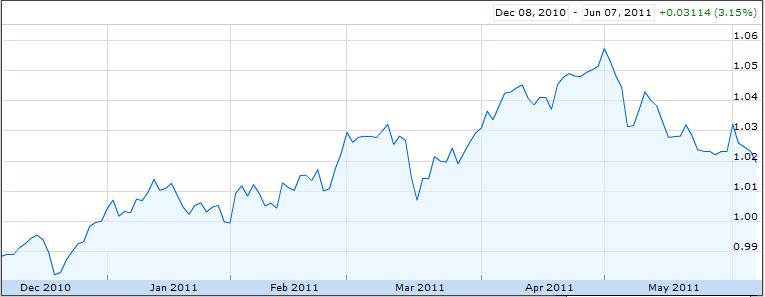
In April, I wrote a post entitled, “Economic Theory Implies Canadian Dollar will Fall,” in which I argued that the currency’s impressive rise was belied by fundamentals. It seems the gods of forex read that post; since then, the Loonie has fallen 3% against the US dollar alone. Based on my reading of the tea leaves, the loonie will fall further over the coming months, and finish the year below parity.

My contention is basically that investors are falsely treating the Loonie is a high-yield growth currency, and hence, bidding up its value. There are a few reasons why I believe this viewpoint is completely erroneous. First of all, Canada’s economy is both plain and mature. While it is indeed rich in natural resources would seem to make it stand-out, commodities exports account for only a small portion of GDP. Given that the US absorbs 75% of its exports, it’s no accident that Canada’s economic fortunes are tied closely to the US. Finally, Canadian interest rates are pretty mediocre, which means there is neither a strong monetary nor an economic impetus for buying the Loonie against the dollar.
While Canadian GDP and inflation have exceeded analysts’ predictions, the consensus expectation is still for the Bank of Canada to hold off on tightening until September or so. Even the most bullish forecasts show a benchmark interest rate of only 1.75% by the end of 2011 and perhaps 3% at the end of 2012. In other words, it will be a long time before the Loonie becomes a viable target currency for the carry trade.
According to OECD models, the Canadian dollar is overvalued by 17% against the Dollar on a purchasing power parity (ppp). While it is generally dubious to apply this concept to currency markets, I think it’s reasonable to invoke it when analyzing the USD/CAD. The two economies share more than just a border. As I said, their economies are closely intertwined, and goods, services (and people!) move freely between the two. Thus, you would expect that large discrepancies in prices should disappear over the medium-term. In fact, the Canadian trade balance recently slipped into deficit for the first time in 40 years (corresponding with the Loonie’s record high level), which shows just how quickly consumers can shift their attention south of the border. That means that either Canadian prices have to decline (something which retailers are always reluctant to effect) or the Loonie must drop further against the Dollar.
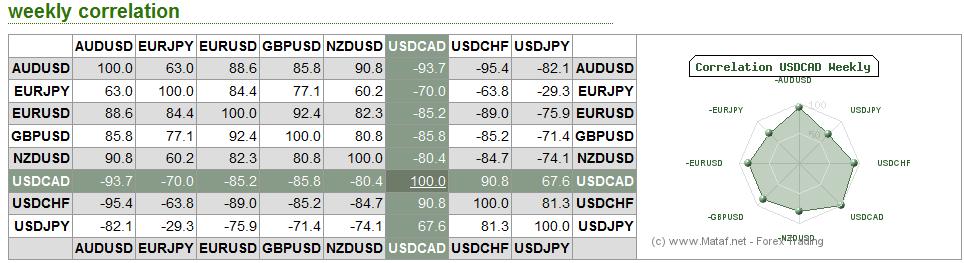
Of course, there is a mitigating factor: the US dollar may fall even faster than the loonie. While it would seem impossible to tease apart the loonie’s rise from the dollar’s fall (since a rise in CADUSD inherently reflects both), we can still make an educated guess. For example, consider that the Canadian dollar is strongly correlated (i.e. greater than 80 or less than -80 in the chart above) with almost every other major currency, relative to the US dollar. If the correlation was low, than it would imply that the Canadian dollar is fluctuating (in this case falling) for endemic reasons. In this case, however, the almost perfect correlation with the majors shows that it is almost definitely a US dollar spike rather than a Canadian dollar correction.
Whether this trend continues then, depends more on the health of the US dollar and less on what investors think about the loonie.

Read more

Is the Chinese Yuan the Most Reliable Forex Trade?

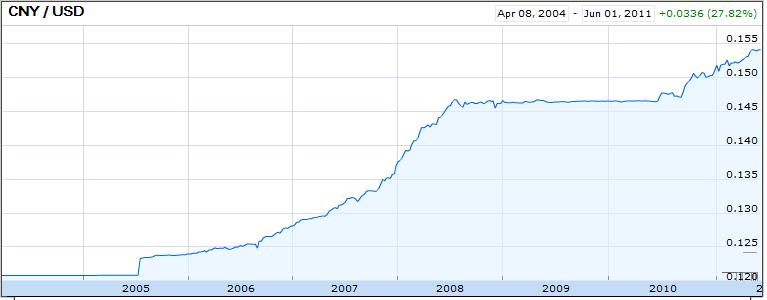
Over the last six years, the appreciation of the Chinese Yuan has been as reliable as a clock. Since 2005, when China tweaked the Yuan-Dollar peg, it has risen by 28%, which works out to 4.5% per year. If you subtract out the two year period from 2008-2010 during which the Yuan was frozen in place, the appreciation has been closer to 7% per year. There is no other currency that I know of whose performance has been so consistently solid, and best of all, risk-free!
As I wrote in an earlier post on the subject, the economic case for further appreciation is actually somewhat flimsy. When you factor in the 5-10% inflation that has eroded the value of the Yuan over the last few years, its appreciation in real terms has more than exceeded the 25-40% that economists and politicians asserted as the margin by which it was undervalued. While prices for many services remain well below western levels, prices for manufactured goods already equal or exceed those that Americans pay. (As a resident of China, I can assure you that this is the case!). Given that Chinese GDP per capita (a proxy for income) is 12 times less than in the US, that means that relative price levels in China are already significantly greater than the US. Thus, further appreciation would only cause further distortion.
Regardless, investors continue to brace for further appreciation, and expectations of 5-6% for the foreseeable future are the norm. Even futures contracts – which typically lag actual appreciation because of their non-deliverable nature – are pricing in higher expectations for appreciation. Perhaps the greatest indication is that 9% of all of the capital pouring into China is so-called “hot-money.” That means that despite the 27% appreciation to date, a substantial portion of investment in China is connected only to the expectation for further Yuan appreciation.
Even though the Yuan is not fully-tradeable, its continued rise has serious implications for forex markets. First of all, there will be follow-on effects for other currencies. Almost every emerging market economy competes directly with China, and all are thus keenly aware that China pegs its currency against the US dollar. By extension, many of these economies feel they have no choice but to intervene daily in forex markets to prevent their respective currencies from appreciating faster than the RMB.
At the very least, the appreciation in Asian and Latin American currencies will keep pace with the Yuan: “This is a long-term secular trend for emerging market currencies especially in Asia. Asian currencies have long been undervalued and they are on a convergence path with the United States and the G7 more broadly and that’s going to lead to an appreciation,” summarized one analyst.
All of this action will cause the dollar to depreciate. The Chinese Yuan alone accounts for 20% of the Federal Reserve Bank’s trade-weighted dollar index, and Asia ex-Japan accounts for another 20%. Regardless of the other G4 currencies perform, that means that a conservative 7% annual appreciation in Asia will drive a minimum 3% annual decline in the trade-weighted value of the dollar. Even worse is that this cause a broad loss of confidence in the dollar, driving the dollar lower across-the board. And this doesn’t even aaccount for the multiplier effect that net exporters will no longer need to indiscriminately accumulate dollar-denominated assets. China, itself, has unloaded part of its massive hoard of US Treasury securities for five consecutive months.
The implications for how long-term investors should position themselves are clear. Unfortunately, while further appreciation in the Chinese Yuan is all but guaranteed, achieving exposure to this appreciation is beyond difficult. Neither of the ETFs that claim to represent the Yuan (CNY, CYB) have budged over the last couple years, and they are a poor substitute for the actual thing. In other words, your only chance for exposure is indirectly via Chinese stocks and bonds, which are far from transparent and an extremely dubious investment. Or you could try opening a Chinese Yuan bank account with the Bank of China (which now has branches in the US), but it’s unclear whether you will be able to capture 100% of gains from the Yuan’s appreciation.
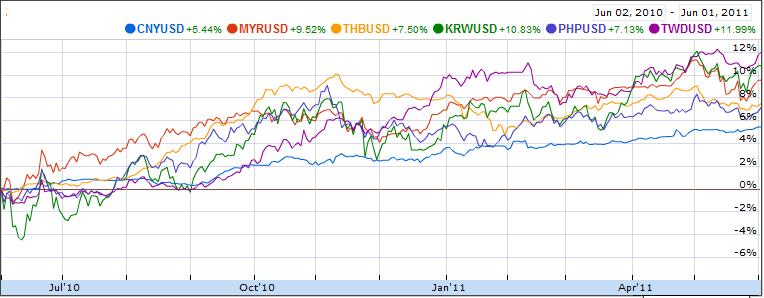
Otherwise, emerging market Asia seems like a pretty good proxy. Of course, you need to be aware that even though the Korean Won, Malaysian Ringgit, Thai Baht, New Taiwan Dollar, Indonesian Rupiah, Philippine Peso, etc. will probably at least match the rise in the Yuan, they are imperfect substitutes for the Yuan, since they are driven more by country-specific factors than by association to China.

Read more

Has the US Dollar Hit Bottom?

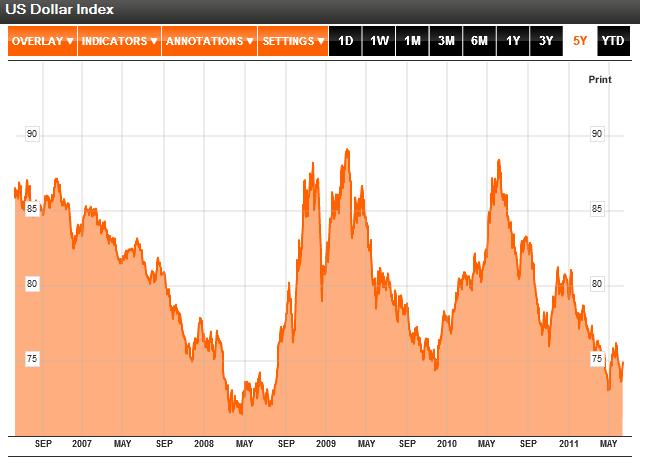
In April, I declared that the dollar would rally when QE2 ended. That date – June 30 – is now only a few weeks away, which means it won’t be long before we know whether I was right. Meanwhile, the dollar is close to pre-credit crisis levels on a composite basis, and has already fallen to record lows against a handful of specific currencies. In other words, it’s now do-or-die for the dollar.

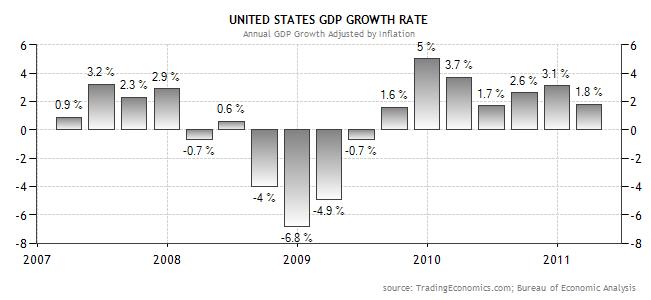
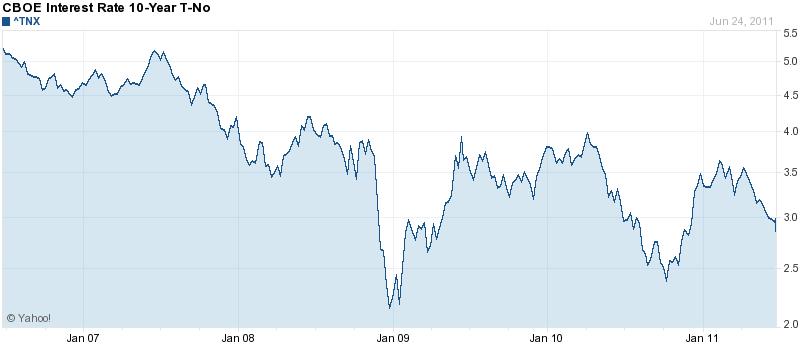
Since my last update, a number of things have happened. Commodity prices have continued to rise, and inflation has ticked up slightly. Meanwhile, GDP growth has moderated, the unemployment rate has stagnated at 9%, and the S&P has fallen slightly as investors brace for the possibility of an economic downturn. Finally, long-term interest rates have fallen, despite concerns that the US will be forced to breach the debt ceiling imposed by Congress.
From the standpoint of fundamentals, there is very little to get excited about when it comes to the dollar. While the US is likely to avoid a double-dip recession (the case for this was most convincingly made by TIME Magazine, of all sources), GDP growth is unlikely to rebound strongly. Exports are growing, but slowly. Businesses are investing (in machines, not people), but they are still holding record amounts of cash. Consumption is strong, but unsustainable. The government will do what it can to keep spending, but given that the deficit is projected at 10% of GDP in 2011 and that Congress is playing hardball with the debt ceiling, it can’t be expected to provide the engine of growth.
Meanwhile, Ben Bernanke, Chairman of the Fed, has implied that QE2 will not be followed by QE3. Still, he warned that “economic conditions are likely to warrant exceptionally low levels for the federal-funds rate for an extended period.” With low growth, high unemployment, and low inflation, there isn’t any impetus to even think about raising interest rates. In fact, Bernanke and his cohorts will continue to do everything in their power to hold down the dollar, if only to provide a boost to exports. Bill Dudley, head of the New York Fed, intimated in a recent speech that the Fed’s current monetary policy is basically a response to emerging market economies’ failure to allow their currencies to rise.
In short, if I was arguing that fundamentals would provide the basis for renewed dollar strength, I would have a pretty weak case. As I wrote a few weeks ago, however, there is a wrinkle to this story, in the form of risk. You see- the dollar continues to derive some significant support from risk-averse investors, as evidenced by the fact that Treasury yields have fallen to record lows.

Ironically, demand for the US dollar is inversely proportional to the strength of US fundamentals. As the US economy has rebounded, investors have become more comfortable about risk, and have responded by unloading safe haven positions in the dollar. With the US recovery faltering, investors are slowly moving back into the dollar, re-establishing safe haven positions. While the dollar faces some competition in this regard from the Franc and the Yen, it still compares favorably with the euro and pound.
In fact, some traders are betting that the dollar’s fortunes may be about to reverse. It has fallen 15% over the last year, en route to a 3-year low. With short positions so high, it would only take a minor crisis to trigger a short squeeze. Said the CEO of the world’s largest forex hedge fund (John Taylor of FX Concepts): “We see a big upside USD catalyst in the next ’3 or 4 days’ on the grounds that…’Our analysis of the markets has shown that they are very, very dangerous.’ ”
For what it’s worth, I also think the dollar is oversold and expect a correction to take hold at some point over the next month.
SocialTwist Tell-a-Friend

Read more

Pound Stagnates, Lacking Direction

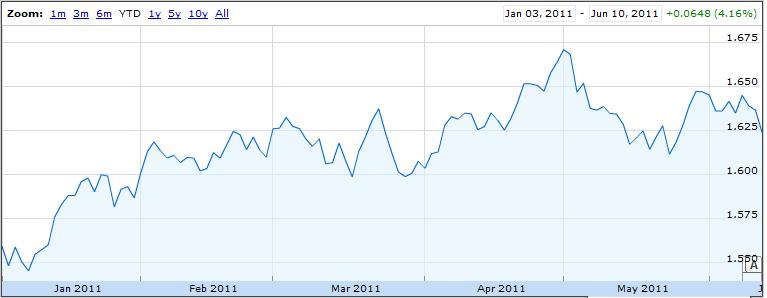
The British Pound has struggled to find direction in 2011. After getting off to a solid start – rising 4% against the US dollar in less than a month -  the Pound has since stagnated. At 1.625 GBP/USD, it is now at the same level that it was at five months ago. Given the paltry state of UK fundamentals, the fact that it still has any gains to hold on to is itself something of a miracle.

The Pound’s failure to make any additional headway shouldn’t come as a surprise. First of all, the Pound is not a safe haven currency. That means that the only chance it has to rise is when risk is “on.” Unfortunately, the Pound also scores pretty low in this regard. Annual GDP growth is currently a pathetic .5%, and is projected at only 1.8% for the entire year. Inflation is high, and both the trade balance and the current account balance are in deficit. Deficit spending has caused a surge in government debt, and there is a possibility that the UK could lose its AAA credit rating.
Investors might be willing to overlook all of this if interest rates were at an attractive level. Alas, at .5%, the Bank of England’s (BOE) benchmark rate is among the lowest in the world. Moreover, it isn’t expected to begin hiking rates for many months, and even then, the pace will be slow. Simply, the economy is too fragile to support a serious tightening of monetary policy. Interest rate futures reflect a consensus expectation that rates will be only 75 basis points higher one year from now.
If that’s the case, why hasn’t the Pound crashed entirely? To be fair, the Pound is losing groroundround against both the euro and the franc, the former of which has it bested in economic grounds while the latter is cashing in on its status as a safe haven currency. On the other hand, the Pound is still up for the year against the US dollar and Japanese Yen, both of which are also safe haven currencies.
It could be the case that the Pound is simply not the ugliest currency, since all of the charges that can be leveled against it can similarly be leveled against the dollar. Head-to-head, it’s actually quite possible that the Pound still wins, if only because its interest rates are slightly higher than the US. Or, it could be the case that investors still believe the BOE will come around and begin hiking rates. After all, at the beginning of the year (when by no coincidence, the Pound was still rising), expectations were that the BOE would have already hiked twice by this time, bringing the benchmark to a level that would make the Pound attractive to carry traders. While the BOE hasn’t followed through, carry traders may be sticking around, since the opportunity cost of holding the Pound is basically nil.
As for whether the Pound correction (that I first observed last month) will continue, that depends entirely on the BOE. Unfortunately, there is very little reason to believe that the UK economy will suddenly pick up, and hence very little reason to expect the BOE to suddenly tighten. At some point, earning .5% interest on Pounds will become unattractive to investors. Until that day comes, that might stick with the Pound out of sheer inertia. While the Pound may hold its value for this reason, I don’t think it has any hope of appreciating further this year.

Read more

S&P 500 Decouples from Euro?

While I have written quite about forex correlations in recent posts, the focus has primarily been on correlations that exist between currencies. In this post, I would like to address a correlation that exists between currencies and other forex markets- specifically the relationship between the Euro and US stocks.

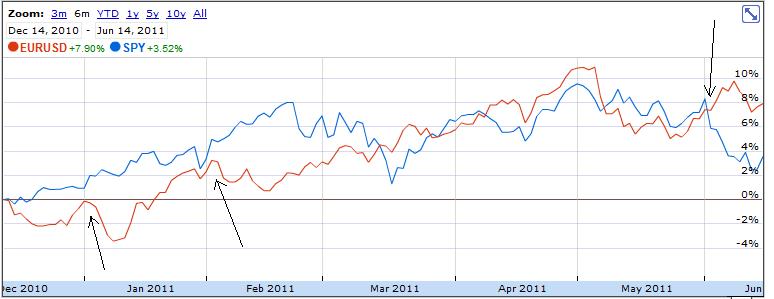
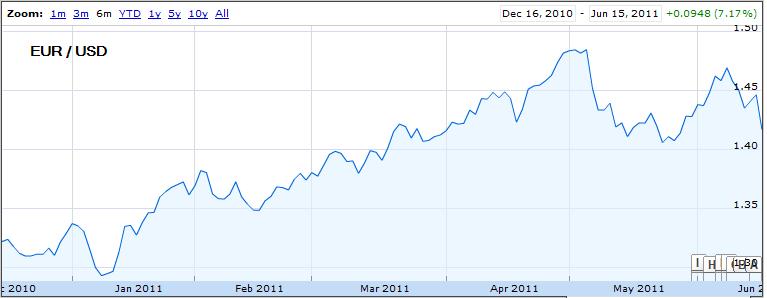
If you look at the chart above, you can see that an unmistakable correlation exists between the S&P500 and the EUR/USD that stretches back at least six months. Generally speaking, when the EURUSD has risen, so has the S&P 500, and vice versa. In fact, this correlation is so airtight that one analyst recently discovered that the two financial vehicles often reach intra-day highs and lows within minutes of one another!
Why is this the case? In a nutshell, it is because the Euro – especially relative to the dollar – is a proxy for risk appetite. The same is necessarily true for US stocks. When investors are confident in the strength of the global economic recovery and the possibility of crisis is distant, the euro will rise. This has nothing to do with fundamentals in Europe, which are probably at least as bad as they are in the US. Of course, it may be connected with dollar weakness, since it is arguably the case that quantitative easing has both depressed the dollar and buoyed US stocks.
As I intimated in the title of this post, however, the S&P recently decoupled from the euro. Since the beginning of June, US equities have declined sharply, to the extent that they have given back most of their gains in the year-to-date. The EUR/USD, meanwhile, continued rising all the way until last week. While this has happened on a couple previous occasions, this was perhaps the sharpest break between the two.
I’m personally at a loss to explain why this happened. It has been conjectured that the driving force behind the correlation is algorithmic trading, and that hence, it must also represent the source of the break. In other words, high-frequency traders – which account for an ever-increasing proportion of forex volume – tweaked their trading algorithms so as not to buy the S&P 500 when the EURUSD rises, and vice versa.
It’s probably also the case that S&P 500 was falling for endogenous reasons- specifically a decline in GDP growth and earnings expectations which need not necessarily reflect itself in a stronger euro. In fact, in a normal functioning market, you would expect an inverse correlation; strong US economic fundamentals should translate into both a strong dollar and rising stocks. Could it be that worsening fundamentals are manifesting themselves in the form of a weak dollar and weak stocks?
Alas, the correlation has re-established itself over the last week, which means this is largely a moot issue. At the very least, it’s still worth being aware of, both insofar as it remains intact and in the event that it breaks down again.

Read more

Euro Nears Breaking Point

It’s deja vu all over again in the forex markets as another twist in the sovereign debt crisis has sent the euro tumbling by the greatest margin in nearly a year. It was only last month that I posted “The Euro (Still) has a Greek Problem,” and yet, forex markets are once again reacting to the possibility of a Greek default as thought it were a new development. At the very least, investors finally seem to be acknowledging the inevitable.
There have been several factors at work in this latest episode. On Monday, S&P downgraded its credit rating for Greece to CCC, following on a similar move by Moody’s. That means that Greece’s sovereign credit rating is now the lowest in the world, behind such eminent economies as Grenada and Ecuador. While the move was hardly noteworthy in itself, it represents one more straw on the camel’s back.
Greece’s government is increasingly unstable, and Prime Minister George Papandreou has become so desperate that he has suggested forming an alliance with Greece’s most powerful opposition party. Meanwhile, violent riots outside Greek Parliament have reportedly become a daily occurrence, as the Greek populace has proven unwilling to accept wage cuts and tax increases.
As if that weren’t enough, there is tremendous uncertainty surrounding the next stage of the Greek bailout. No one can agree on what amount to give and what should be stipulated in return. Some parties think that private investors should be involved in the bailout by taking a “haircut” on the bonds that they own. Some members of the eurozone are balking about contributing any funds at all, wary of justifying it to their own citizens and that it is merely forestalling the inevitable.
I think the NYTimes offered the best summary: “Funding fatigue is growing in the north European creditor countries, especially Germany, the Netherlands, Finland and Austria, just as austerity fatigue is mounting in Greece.” When you consider that Greek interest rates and credit default swap spreads have surged to record highs, it seems that default is really inevitable. If the IMF and European Union are so determined, they can push off default until 2013. Still, default now or default then is still default.
At this point, then, the only real question is what happens when Greece defaults. Will it be forced to leave the Eurozone? Will that push the rest of the Eurozone fringe closer towards default? Will the Euro collapse and cease to exist as a currency? What will happen then?
Unfortunately, I think the answer to all of these questions is yes. At the very least, Greece will be forced out of the eurozone. Bondholders will push interest rates in Ireland, Spain, and Portugal up to double-digit levels, trapping them in the same cycle in which Greece is currently ensnared. Given the exposure of French and German banks to the sovereign debt of financially troubled eurozone members, they will also require state bailouts, and so on.
In a recent op-ed published in The Financial Times, celebrity economies Nouriel Roubini argued that the only way to avoid a complete eurozone meltdown is if the euro depreciates rapidly “to restore competitiveness to the periphery” or if the European Union is able to rapidly achieve complete fiscal and economic union. Roubini argues that the former is difficult because of the ECB’s hawkishness, while the latter is precluded by political hurdles that remain too formidable to overcome.
As Greece inches ever closer to default, the markets will increasingly become gripped by utter uncertainty over the questions that I posed above. Central Banks will stop accumulating euro-denominated assets, and investment funds will similarly shun Europe. (In fact, there is already evidence that this is happening). While European interest rates are attractive relative to the rest of the G4, they are hardly enough to compensate investors for this uncertainty. And when the markets come to terms with this, the euro might finally reach its breaking point.

Read more

Forex Volatility Continues Rising

This week witnessed another flareup in the eurozone sovereign debt crisis. As a result, volatility in the EUR/USD pair surged, by some measures to a record high. Even though the Euro rallied yesterday and today, this suggests that investors remain nervous, and that going forward, the euro could embark on a steep decline.

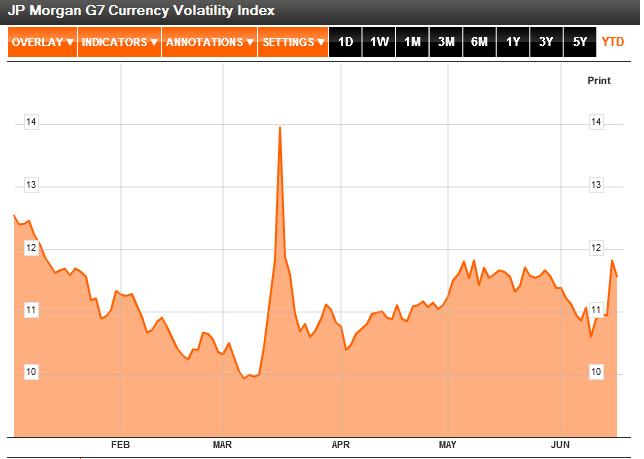
There are a couple of forex volatility indexes. The JP Morgan G7 Volatility Index is based on the implied volatility in 3-month currency options and is one of the broadest measures of forex volatility. As you can see from the chart above, the index is closing in on year-to-date high (excluding the spike in March caused by the Japanese tsunami), and is generally entrenched in an upward trend. Barring day-to-day spikes, however, it will take months to confirm the direction of this trend.
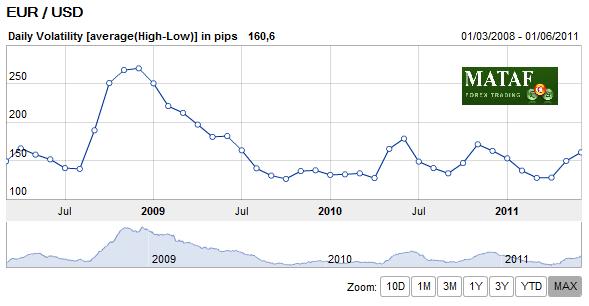
For specific volatility measurements, there is no better source of data than Mataf.net (whose founder, Arnaud Jeulin, I interviewed only last month). Here, you can find data on more than 30 currency pairs, charted across multiple time periods. You can see for the EUR/USD pair in particular that volatility is now at the highest point in 2011 and is closing in on a two-year high.

Meanwhile, the so-called risk-reversal rate for Euro currency options touched 3.1, which is greater than the peak of the credit crisis. This indicator represents a proxy for investor concerns that the Euro will collapse suddenly, and its high level suggests that this is indeed a growing concern. In addition, implied volatility in options contracts has jumped dramatically over the last week, which confirms that investors expect the euro to move dramatically over the next month.
What does all of this mean? In a nutshell, it shows that panic is rising in the forex markets. Last month, I used this notion as a basis for arguing that the dollar safe-haven trade will make a come-back. This would still seem to be the case, and should also benefit the Swiss Franc, which is nearing an all-time high against the euro. Naturally, it also implies that forex investors remain extremely concerned about a continued decline in the euro, and are rushing to hedge their exposure and/or close out long positions altogether.
Mataf.net suggests that this could make the EUR/USD an interesting pair to trade, since large swings in either direction will necessarily create opportunities for traders. While I have no opinion on such indiscriminate trading [I prefer to make directional bets based on fundamentals], I must nonetheless acknowledge the logic of such a strategy.

Read more

Japanese Yen In “No Man’s Land”

This, according to a hedge fund manager that has decided to cancel all of his fund’s bearish bets on the Japanese Yen. The reason: the yen is rising, and it’s unclear when – or even if – the government will intervene to push it back down. Even though the yen’s strength is fundamentally illogical, it seems that investors are growing increasingly wary of betting against it.

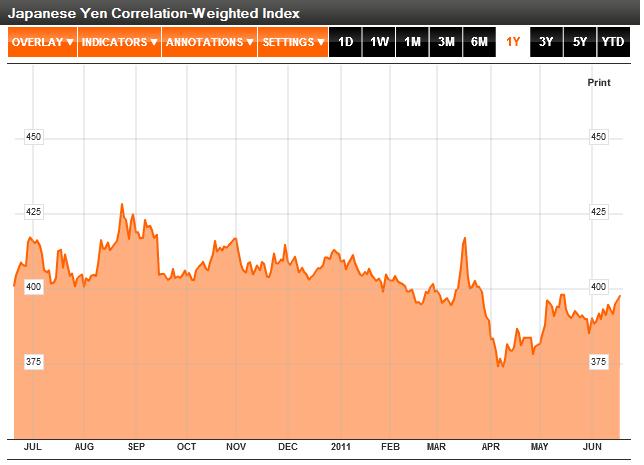
As I pointed out in my previous post on the Yen (“Japanese Yen Strength is Illogical, but Does it Matter?“), the yen has actually fallen over the last twelve months, on a correlation weighted basis (though to be fair, it has staged a pretty impressive comeback since the beginning of April). Unfortunately, investors mainly care about how it is performing against a handful of key currencies, namely the US Dollar. Simply, the yen continues to rise against the dollar, and it is unclear when it will stop.
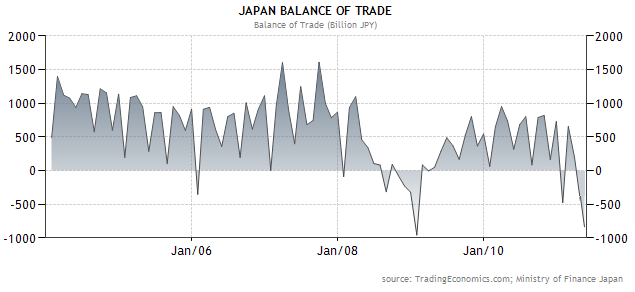
Japanese government analysis has indeed confirmed that “speculators” are behind the strong yen, as the alleged wide-scale repatriation of yen by Japanese insurance companies has yet to materialize. Of course, there isn’t really much doubt: Japan’s economy is contracting, due to decrease in output spurred by the tsunami. In May, it recorded its second largest monthly trade deficit ever.

Meanwhile, interest rates and bond yields are pathetically low, and the Bank of Japan is being urged to expand its asset buying program, which would theoretically result in a devaluation of the yen. As  a result, retail Japanese forex traders (nicknamed “Mrs. Watanabes“) have resumed shorting the Yen as part of a carry trade strategy.
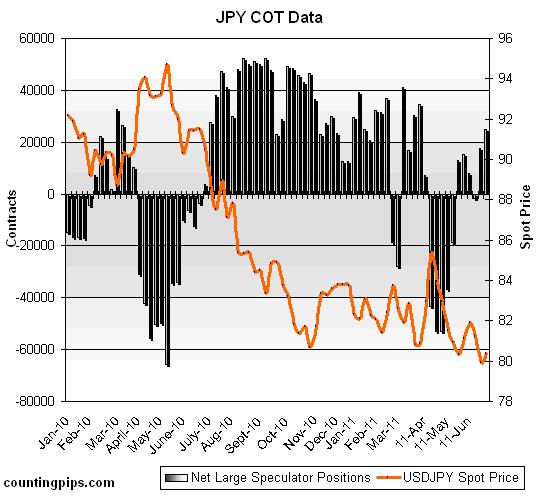
Alas, speculators either don’t share their pessimism or are running out of patience. While everyone continues to assume that the BOJ will intervene if the Yen rises to 80 against the dollar, no one can be sure whether the line in the sand might not be 78 or even 75. At this point, intervention seems to hinge more on politics than on economics, which means predicting it is beyond the scope of this post. In other words, “There is too much uncertainty and volatility in markets right now to make that yen trade appealing.” And sure enough, the most recent Commitments of Traders data shows that speculators have been re-building their yen long positions over the last month.

In the end, the speculators are probably right. The Bank of Japan has intervened twice over the last twelve months, and the impact has always been short-lived. Besides, given that many speculators still remain committed to shorting the yen, it remains extraordinarily vulnerable to the kind of short squeeze that sent it soaring 5% in a single session en route to the record high it touched in March.
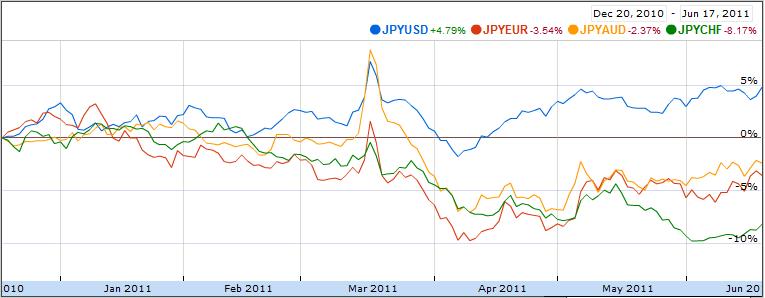
I’m personally still bearish on the yen, but I also think it’s too risky to short it against the dollar, which seems to be declining for its own reasons. As you can see from the chart below, the yen has fallen against virtually every other major currency. Yen shorters, then, might be wise to avoid the dollar altogether and focus instead on any number of other currencies.

Read more

Is it Possible to Trade Forex Part-time?

This week, I came across an article in the San Francisco Gate (which, incidentally, has really ramped up its forex coverage over the last year) that addressed this very topic. Given that part-time forex traders probably outnumber those that practice the craft full-time, such an article was long overdue.
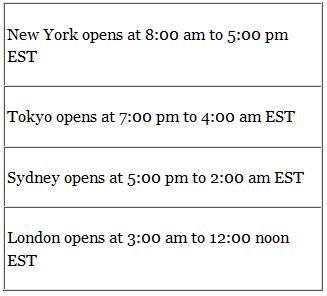
In sum, the author advises part-time traders to concentrate their trading during the busiest times of the day, or failing that, to simply trade the most active currency pairs during the period of the day that one happens to have time to trade. For example, if you wish to trade the USD/EUR but only have a limited amount of time to do so, you are advised to trade the opening of the New York and/or London sessions, at 8AM EST and 3AM EST, respectively. Alternatively, if you only have time to trade from midnight to 2am, for example, you are advised to trade currency pairs in which the quote currency is the Yen, because during that time the Tokyo session is “in full swing.”

Alas, this kind of strategy is based on a very dubious assumption, which is that you should aim to trade the currency pairs which are both the most liquid and most volatile (ignore the contradiction here), because this will yield the most profits. In other words, it’s easy to capture profits when trading pairs that tend to bounce around a lot and which are cheap and easy to buy and sell. Right?
If you read the Forex Blog with any regularity and are ware that my bend is towards fundamental analysis, it’s probably already obvious to you that I don’t think this is necessarily the case. Consider that forex is a zero-sum game. In other words, on average, 50% of traders win and 50% lose. [When you account for trading costs (i.e. spreads), its probably closer to 30% win and 70% lose, but let's ignore this for the sake of argument]. Thus, the way I see it, a trader that enters the market during the busiest times has the same chance of winning (~50%) as a different trader that enters the market during the least busy time of day. Either way you cut it, someone has to win and someone has to lose, and no amount of liquidity or volatility can rectify this situation.
Thus, my advice for part-time traders is to forget trading altogether. If you don’t have the time to constantly monitor the market, pore over charts, and develop technical strategy, the odds of winning are pretty low. On the other hand, why not shift your focus from trading to investing? Trading is difficult under the best of circumstances and even more difficult when you don’t have enough time to make a real commitment.

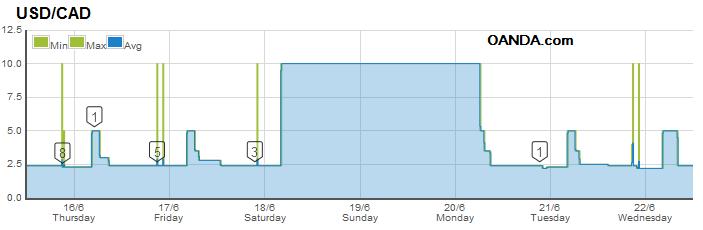
The only way around this is to shift your time horizon from minutes to days – or even weeks. This way, it won’t matter when you have time to trade. Spreads might be marginally higher (as evidenced in the spikes in he chart above, which shows how spreads fluctuate over time) for the USD/EUR at midnight than at 8am, but if you’re planning on holding the pair for more than 10 seconds (and your target profit is greater than 15 pips), this is basically irrelevant.
This way, you also don’t have to worry about carefully planning your entry and exit into positions. Entering a swing trade with a targeted profit of 500pips is probably just as good at 4am as it is at 7am, all else being equal. While this doesn’t necessarily increase the odds of success (above 50%), at least it gives you a great deal more flexibility in being a part-time trader.

Read more

Swiss Franc is the Only Safe Haven Currency

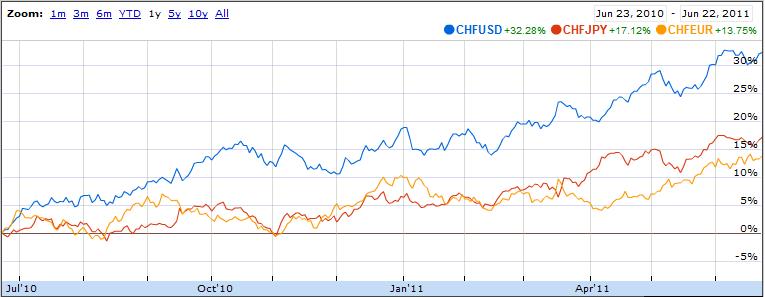
According to conventional market wisdom, there are three safe haven currencies: the Swiss Franc, Japanese Yen, and US Dollar. It is to these currencies that investors flock whenever there is a crisis, or merely an outbreak of uncertainty, and for much of the period following the collapse of Lehman Brothers, the three were closely correlated. As you can see from the chart below, however, one of these currencies has begun to distinguish itself from the other two, leading some to argue that there is now only one true safe haven currency: the Swiss Franc.

What’s not to like about the Franc? It boasts a strong economy, low inflation, and low unemployment. Unlike the US and Japan, Switzerland is not plagued by a high national debt and perennial budget deficits. Its monetary policy has been extremely conservative: no quantitative easing, asset-purchases, or any other money printing programs with euphemistic names.
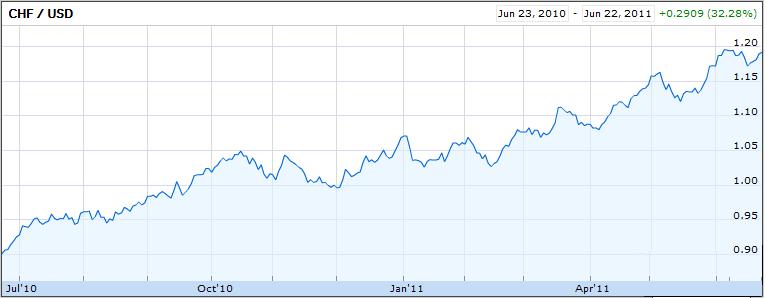
Ironically, the only thing that makes investors nervous about the franc is that it has already risen so much. Remember when it reached the milestone of parity against the dollar in 2010? Since then, it has appreciated by an additional 20%, and seems to breach a new record on an almost weekly basis. The same goes for the CHF/EUR and CHF/JPY. The President of Switzerland’s export association is expecting further gains: “Parity is a realistic scenario. Given the indebtedness of the eurozone and the strong attraction of the franc, the euro is likely to continue to lose value.”

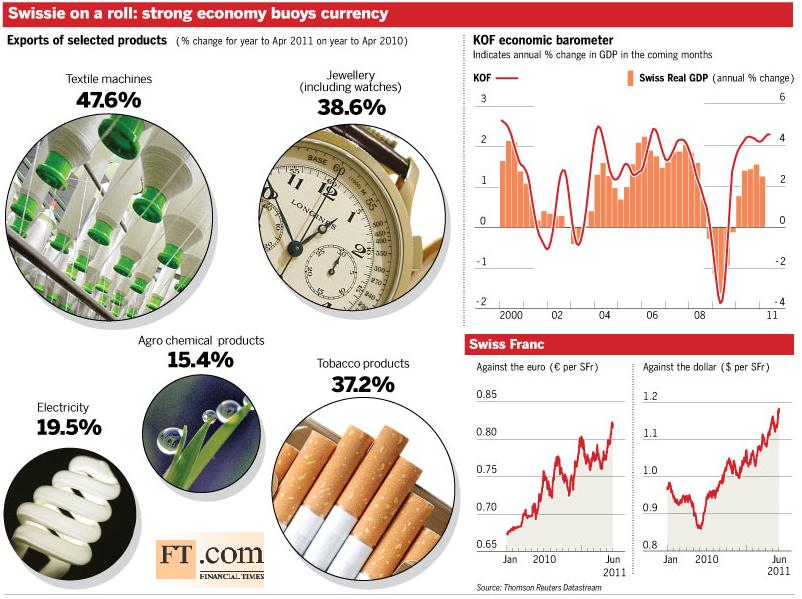
Given that Swiss exports have surged in spite of (or even because of) the rising Franc, however, he has very little to worry about at the moment. As you can see fromt he graphic below (courtesy of the Financial Times), the balance of trade continues to expand, and has exploded in a handful of key sectors. To be sure, economists expect that this situation will eventually correct itself and are already moving to revise downward 2011 and 2012 GDP growth estimates. Then again, they made the same erroneous predictions in 2010.
The main variable in the Swiss Franc is the Swiss National Bank (SNB). Having booked a loss of CHF 20 Billion from failed intervention in 2010, the SNB is not in a position to make the same mistake again. In fact, SNB President Philipp Hildebrand has not even stooped to verbal intervention this time around, undoubtedly cognizant of the fact that he has very little credibility in forex markets.
At the same time, the SNB is not in any hurry to raise interest rates, lest it stoke further speculative interest in the Franc. Its June meeting came and went without any indication of when it might tighten. Interest rate futures currently reflect an expectation that the first rate hike won’t come until March 2012. Thus, the downside of holding the Franc is that it will continue to pay a negative real interest rate. The only upside, then, is the possibility of further appreciation. Fortunately, the SNB is unlikely to stop the Franc from rising, since it serves the same monetary end as higher interest rates. In other words, a more valuable Franc serves as a direct check on inflation because it lowers the cost of commodity imports and should (eventually) soften demand for Swiss exports.
It is possible that the Swiss Franc will suffer a correction at some point, if only because it rose by such a large margin in such a short period of time. On the other hand, given that its economy has proved its ability to withstand the Franc’s appreciation, it’s no wonder that investors continue to bet on its rise

Read more

NO QE3: What are the Implications for the Dollar?

The verdict is nearly in; there will be no QE3. The second round of quantitative easing (“QE2”) will expire at the end of this month, and while it will not be unwound for quite some time, the Fed has indicated that it will not be followed by yet another round. The question on the minds of forex traders, of course, is what does this mean for the Dollar?
In his most recent press conference, Ben Bernanke, himself, indicated that QE3 was unlikely. According to a survey conducted by Bloomberg News, the majority of FX analysts (65%) believe him. Simply, the circumstances don’t support further easing. To be sure, the unemployment rate remains high, and the economy is teetering on the verge of double-dip recession. However, the last two rounds did little to address either of these problems, and companies have hoarded cash rather than investing in new plant and workers.
Interest rates are still hovering around record lows, and there isn’t anything to be gained from trying to lower them further. Besides, given that inflation is now above 3% – due to an explosion in good and energy prices – QE3 would simply be too risky. Economist Ken Goldstein summarized the situation as follows: “We will come to the end of QE2 and largely we mark about how little happened when it ended and that’s also an argument about why there may not be persuasive argument to do a QE3.”
On the other hand, there are some analysts who think that QE3 is inevitable (29%). PIMCO’s Bill Gross, manager of the world’s biggest bond fund, recently indicated that, “Next Jackson Hole in August will likely hint at QE3/interest rate caps.” (Personally, I think that he’s probably just bitter that his forecast of a decline in Treasury Bond prices hasn’t materialized). One columnist wrote that the Fed’s arm will be twisted by the ongoing collapse of the housing market, while others have argued that the recent decline in the S&P 500 will spur the Fed into action. Most of us, however, believe that the Fed will adopt a wait-and-see approach before ultimately conceding that more easing is necessary.
For now at least, then, the prevailing assumption is that there will not be a QE3. As for how forex markets have digested this news, they have taken it in stride. The Dollar is now holding its value, and as I wrote in a previous post, it may even have bottomed out. Of course, it doesn’t hurt that the Euro is being punished by another flare-up in the sovereign debt crisis and investors are getting nervous about bubbles in emerging market currencies, all of which provide support for the dollar.
The fact that QE2 will soon end without having triggered financial apocalypse or hyperinflation – as some cassandras initially predicted – is something that is worth nothing. Of course, the proceeds of QE1 and QE2 will be recycled indefinitely into the markets, and forex investors can’t completely put quantitative easing behind them. Still, that there won’t be any more additional cash injected into commodities markets and emerging economy asset markets means that one of the main sources of downward pressure on the dollar has been eliminated.
Ironically, it is possible that the unveiling of QE3 could actually cause the dollar to rally. The reason is that there is still a tremendous amount of uncertainty in the markets, which provides the dollar with some safe haven demand. If the Fed were to concede that all is not well on the economic front and respond by more money printing, it could drive some safe haven flows into the US, even to the extent that it would overwhelm outflows driven by concerns over inflation.
Personally, I think the dollar will continue to hold its value, and perhaps even appreciate slightly in the near-term, as forex markets dither over the way forward.
http://www.forexblog.org/2011/06/has-the-us-dollar-hit-bottom.html

Read more

Emerging Market Currencies Brace for Correction

“It was the spring of hope, it was the winter of despair,” begins Charles Dickens’ The Tale of Two Cities. In 2011, the winter of despair was followed by the spring of uncertainty. Due to the earthquake/tsunami in Japan, the continued tribulations of Greece, rising commodity prices, and growing concern over the global economic recovery, volatility in the forex markets has risen, and investors are unclear as to how to proceed. For now at least, they are responding by dumping emerging market currencies.

As you can see from the chart above (which shows a cross-section of emerging market forex), most currencies peaked in the beginning of May and have since sold-off significantly. If not for the rally that started off the year, all emerging market currencies would probably be down for the year-to-date, and in fact many of them are anyway. Still, the returns for even the top performers are much less spectacular than in 2009 and 2010. Similarly, the MSCI Emerging Markets Stock Index is down 3.5% in the YTD, and the JP Morgan Emerging Market Bond Index (EMBI+) has risen 4.5% (which is reflects declining growth forecasts as much as perceptions of increasing creditworthiness).
There are a couple of factors that are driving this ebbing of sentiment. First of all, risk appetite is waning. Over the last couple months, every flareup in the eurozone debt crisis coincided with a sell-off in emerging markets. According to the Wall Street Journal, “Central and eastern European currencies that are seen as being most vulnerable to financial turmoil in the euro zone have underperformed.” Economies further afield, such as Turkey and Russia, have also experienced weakness in their respective currencies. Some analysts believe that because emerging economies are generally more fiscally sound than their fundamental counterparts, that they are inherently less risky. Unfortunately, while this proposition makes theoretical sense, you can be assured that a default by a member of the eurozone will trigger a mass exodus into safe havens – NOT into emerging markets.

While emerging market Asia and South America is somewhat insulated from eurozone fiscal problems. On the other hand, they remain vulnerable to an economic slowdown in China and to rising inflation. Emerging market central banks have avoided making significant interest rate hikes (hence, rising bond prices) – for fear of inviting further capital inflow and stoking currency appreciation – and the result has been rising price inflation. You can see from the chart above that the darkest areas (symbolizing higher inflation) are all located in emerging economic regions. While high inflation is not inherently problematic, it is not difficult to conceive of a downward spiral into hyperinflation. Again, a sudden bout of monetary instability would send investors rushing to the exits.

While most analysts (myself included) remain bullish on emerging markets over the long-term, many are laying off in the short-term. “RBC emerging market strategist Nick Chamie says his team has recommended ‘defensive posturing’ to clients since May 5 and isn’t recommending new bullish emerging currency bets right now….HSBC said Thursday that it isn’t recommending outright short positions on emerging market currencies to clients but suggested a more ‘cautious’ and selective approach in making currency bets.” This phenomenon will be exacerbated by the fact that market activity typically slows down in the summer chart above courtesy of Forex Magnates) as traders go on vacation. With less liquidity and an inability to constantly monitor one’s portfolio, traders will be loathe to take on risky positions.

Read more

Tide is Turning for the Aussie

“Australia is about to enter a boom that should last decades…The Australian dollar is unlikely to go back to where it was, and manufacturing will shrink in importance to the economy, perhaps even faster than it has been.” This, according to Martin Parkinson, Treasury Minister of Australia. While 30 years from now, Mr. Parkinson’s prognosis might probe to be accurate, I’m not so sure it applies to the period 3 months from now. Here’s why:
First of all, the putative economic boom that is taking place in Australia is being driven entirely by high commodity prices and surging production and exports. Since peaking at the end of April, commodity prices have fallen mightily. You can see from the chart above that there continues to exist a tight correlation between the AUD/USD and commodities prices. As commodities prices have fallen over the last two months, so has the Australian Dollar.

In addition, while demand will probably remain strong over the long-term, it may very well slacken over the short-term, due to declining economic growth across the industrialized world.  Consider also that Australia’s largest market for commodity exports – China – may have difficulty sustaining a GDP growth rate of 10%, and at the very least, new fixed-asset investment (which necessitates demand for raw materials) will temporarily peak in the immediate future.
Finally, the mining sector directly accounts for only 8% of Australia’s economy, which means that only to a limited extent to high commodities prices contribute to the bottom line of Australian GDP. This notion is reinforced by the 1.2% economic contraction in the second quarter – the biggest decline in 20 years – and the fact that GDP is basically flat over the last three quarters. Many non-mining economic indicators are sagging, and the number of corporate bankruptcies is 10% higher than in 2010. In the end, then, the ebb and flow of Australia’s fortune depends less on commodities, and more on other sectors.

Mr. Parkinson’s optimistic forecasts might also be undermined in the short-term by a looser-than-expected monetary policy. The Reserve Bank of Australia last hiked its benchmark interest rate in November 2010, and may not hike again for a few more months due to moderating economic growth and proportionally moderate inflation. Given that an attractive interest rate differential may be driving some of the speculative activity that has girded the Aussie’s rise, a decline in this differential could likewise propel it downward.
That’s because anecdotal reports suggest that the Australian Dollar remains a popular long currency for carry traders, funded by shorting the US Dollar, and to a lesser extent, Japanese Yen. Given that many of these carry trades are heavily leveraged, it wouldn’t take much to trigger a short squeeze and a rapid decline in the AUD/USD. For evidence of this phenomenon, one has to look no further back than May 2010, when the Aussie fell 10-15% in only three weeks.

Ultimately, as one commentator recently pointed out, the Aussie’s 70% rise since 2008 might better be seen as US Dollar weakness (which also catalyzed the rise in commodity prices). The apparent stabilizing of the dollar, then, might let some air out of the currency down under.

Read more

Loonie and Aussie Share Downward Bond

In yesterday’s post (Tide is Turning for the Aussie), I explained how a prevailing sense of uncertainty in the markets has manifested itself in the form of a declining Australian Dollar. With today’s post, I’d like to carry that argument forward to the Canadian Dollar.

As it turns out, the forex markets are currently treating the Loonie and the Aussie as inseparable. According to Mataf.net, the AUD/USD and CAD/USD are trading with a 92.5% correlation, the second highest in forex (behind only the CHFUSD and AUDUSD). The fact that the two have been numerically correlated (see chart below) for the better part of 2011 can also be discerned with a cursory glance at the charts above.

Why is this the case? As it turns out, there are a handful of reasons. First of all, both have earned the dubious characterization of “commodity currency,” which basically means that a rise in commodity prices is matched by a proportionate appreciation in the Aussie and Loonie, relative to the US dollar. You can see from the chart above that the year-long commodities boom and sudden drop corresponded with similar movement in commodity currencies. Likewise, yesterday’s rally coincided with the biggest one-day rise in the Canadian Dollar in the year-to-date.
Beyond this, both currencies are seen as attractive proxies for risk. Even though the chaos in the eurozone has very little actual connection to the Loonie and Aussie (which are fiscally sound, geographically distinct, and economically insulated from the crisis), the two currencies have recently taken their cues from political developments in Greece, of all things. Given the heightened sensitivity to risk that has arisen both from the sovereign debt crisis and global economic slowdown, it’s no surprise that investors have responded cautiously by unwinding bets on the Canadian dollar.

Finally, the Bank of Canada is in a very similar position to the Reserve Bank of Australia (RBA). Both central banks embarked on a cycle of monetary tightening in 2010, only to suspend rate hikes in 2011, due to uncertainty over near-term growth prospects. While GDP growth has indeed moderated in both countries, price inflation has not. In fact, the most recent reading of Canadian CPI was 3.7%, which is well above the BOC’s comfort zone. Further complicating the picture is the fact that the Loonie is near a record high, and the BOC remains wary of further stoking the fires of appreciation by making it more attractive to carry traders.
In the near-term, then, the prospects for further appreciation are not good. The currency’s rise was so solid in 2009-2010 that it now seems the forex markets may have gotten ahead of themselves. A pullback towards parity – and beyond – seems like the only realistic possibility. If/when the global economy stabilizes, central banks resume heightening, and risk appetite increases, you can be sure that the Loonie (and the Aussie) will pick up where they left off.

Read more

الاثنين، 8 أكتوبر 2012

Forex - USD/CAD drops after strong U.S., Canadian data

Forexpros - The U.S. dollar dropped to a 12-day low against its Canadian counterpart on Friday, after the release of globally positive employment data from Canada and the U.S., while concerns over financial difficulties in Greece and Spain continued to weigh on investor confidence.

USD/CAD hit 0.9736 during U.S. morning trade, the pair's lowest since September 21; the pair subsequently consolidated at 0.9746, dropping 0.58%.

The pair was likely to find support at 0.9694, the low of Septemer 17 and resistance at 0.9812, the session high.

Official data showed that the U.S. unemployment rate fell unexpectedly to 7.8% in September, the lowest level in four years, from 8.1% the previous month.

Analysts had expected the unemployment rate to tick up to 8.2% in September.

The report also showed that U.S. private nonfarm payrolls rose by 114,000 in September, beating expectations for a 113,000 increase, following a 142,000 rise the previous month.

In Canada, official data showed that the economy added 52,100 jobs in September, more than the expected 10,000 increase and following a 34,300 rise the previous month.

Canada's unemployment rate ticked up to 7.4% last month from 7.3% in August. Analysts had expected the unemployment rate to decline to 7.0% in September.

But investors remained cautious after a European Union official said that a possible bailout for Spain is not imminent, as concerns grow over the country’s ability to reach its deficit-reduction targets.

On Thursday, Spanish Economy Minister Luis de Guindos said that no bailout was needed, a few hours after European Central Bank President Mario Draghi reiterated that the bank was ready to start purchasing the debt of troubled euro zone states.

Elsewhere, the loonie was also steady against the euro with EUR/CAD dipping 0.03%, to hit 1.2761.

Greek officials were expected to meet on Saturday with members of the Troika, led by the European Commission, the European Central Bank and the International Monetary Fun, with hopes of securing a deal on reforms that would allow fresh aid to the country

Read more

Dollar steady vs. rivals ahead of key U.S. employment reports

Forexpros - The U.S. dollar was steady against most of its major counterparts on Friday, as investors remained cautious ahead of the release of highly anticipated U.S. employment data, while comments by European Cental Bank President Mario Draghi continued to mildly support sentiment.

During European morning trade, the dollar was steady against the euro, with EUR/USD easing 0.04% to 1.3012.

On Thursday, ECB President Mario Draghi reiterated that the bank was ready to start purchasing the debt of troubled euro zone states.

Speaking at the ECB's post-policy meeting press conference, Draghi said the central bank was ready to undertake Outright Monetary Transactions when the prerequisites are in place and reiterated that the ECB was acting strictly within its mandate in undertaking a bond buying program via OMTs.

The ECB left rates on hold at a record low 0.75% earlier, in a widely anticipated decision.

Also Friday, official data showed that German factory orders fell far more-than-expected in August, dropping 1.3% after a 0.3% rise the previous month.

Analysts had expected factory orders to fall by 0.5% in August.

The greenback was almost unchanged against the pound, with GBP/USD dipping 0.01% to 1.6190.

Elsewhere, the greenback was steady against the yen, with USD/JPY edging 0.02% lower to hit 78.46, and higher against the Swiss franc, with USD/CHF adding 0.13% to trade at 0.9317.

Earlier in the day, the Bank of Japan ended a two-day policy meeting by holding the benchmark interest rate close to zero, in a widely expected move.

The central bank held off from more easing after adding to stimulus last month, keeping its asset-purchase fund at JPY55 trillion, despite increased political pressure and signs of an economic contraction.

In addition, the greenback was mixed to lower against its Canadian, Australian and New Zealand counterparts, with USD/CAD inching 0.04% higher to 0.9808, AUD/USD adding 0.08% to 1.0248 and NZD/USD rising 0.29% to hit 0.8241.

The dollar index, which tracks the performance of the greenback versus a basket of six other major currencies, was up 0.05%, to trade at 79.45.

Later in the day, the U.S. was to produce official data on non-farm payrolls and the unemployment rate, as well as a report on average hourly earnings

Read more

Forex - EUR/USD down during the Asian session

Forexpros - The Euro was lower against the U.S. Dollar on Friday.

EUR/USD was trading at 1.3012, down 0.04% at time of writing.

The pair was likely to find support at 1.2805, Monday’s low, and resistance at 1.3032, Thursday’s high.

Meanwhile, the Euro was down against the British Pound and the Japanese Yen, with EUR/GBP shedding 0.04% to hit 0.8036 and EUR/JPY falling 0.15% to hit 102.00.

Read more

Forex - GBP/USD up in Asian trade

orexpros - The British Pound was higher against the U.S. Dollar on Friday.

GBP/USD was trading at 1.6194, up 0.02% at time of writing.

The pair was likely to find support at 1.6067, Wednesday’s low, and resistance at 1.6202, Thursday’s high.

Meanwhile, the British Pound was up against the Euro and down against the Japanese Yen, with EUR/GBP shedding 0.04% to hit 0.8037 and GBP/JPY falling 0.10% to hit 126.94

Read more

Forex - USD/CHF up during Asian trade

Forexpros - The U.S. Dollar was higher against the Swiss Franc on Friday.

USD/CHF was trading at 0.9310, up 0.05% at time of writing.

The pair was likely to find support at 0.9296, Thursday’s low, and resistance at 0.9438, Monday’s high.

Meanwhile, the U.S. Dollar was up against the Euro and down against the Japanese Yen, with EUR/USD shedding 0.02% to hit 1.3014 and USD/JPY falling 0.20% to hit 78.32

Read more

Aussie and Kiwi Lead, Yen Stable on BoJ; US Dollar Steady Ahead of NFPs

How similar the market looks today at this time as it did when this piece was written yesterday. As noted yesterday, “Price action has been mostly mixed on Thursday though trading in the pre-North American hours has resulted in a modest push upwards by high beta currencies and risk-correlated assets.” The only difference this time is that the European currencies are lagging, as the optimism for the move higher has not been European-centric but rather Asian-centric.
Curiously, there’s been little by way of data or central bank action that would suggest high beta currencies and risk-correlated assets should move higher: the Bank of Japan held its stimulus package at ¥55 trillion last night (as suggested in the Real Time News feed, the BoJ was not expected to change its program); and Australian construction data for September showed a drop in activity. It is thus possible that the rebound we’ve seen in the leading Australian and New Zealand Dollars could just be an unwinding of the negative sentiment that has dominated the market in recent weeks (re: China). Coupled with both majors sitting at crucial support levels, it has only take a little nudge to push them higher.
Overall, the markets are relatively calm ahead of the US cash equity open, with the Japanese Yen and US Dollar nearly even on the day, as market participants await the September labor market reading for the US. The Nonfarm Payrolls report due today is not drawing the same attention that previous reports have (for economic and political purposes: will the Federal Reserve ease more? Will NFPs influence the Presidential election?), though given the volatility that this report has generated in the past, we’re not discounting what could be the biggest market moving event of the week.
Taking a look at credit, peripheral European bond yields are lower, indicating potential support for the Euro. The Italian 2-year note yield has decreased to 2.162% (-5.3-bps) while the Spanish 2-year note yield has decreased to 3.122% (-7.6-bps). Similarly, the Italian 10-year note yield has decreased to 5.040% (-7.0-bps) while the Spanish 10-year note yield has decreased to 5.332% (-5.5-bps); lower yields imply higher prices.
RELATIVE PERFORMANCE (versus USD): 10:47 GMT
NZD: +0.33%
AUD:+0.08%
JPY:+0.03%
CAD:-0.04%
GBP:-0.04%
EUR:-0.05%
CHF: -0.11%
Dow Jones FXCM Dollar Index (Ticker: USDOLLAR): -0.02% (-0.07% past 5-days)
ECONOMIC CALENDAR
The economic docket is supersaturated today, with key labor market readings from Canada and the United States scheduled to be released at 08:30 EDT / 12:30 GMT. First, the Canadian data: the CAD Net Change in Employment (SEP) was +10.0K in September, from +34.3K in August, which should keep the CAD Unemployment Rate (SEP) on hold at 7.3%. In terms of the US data: the USD Unemployment Rate (SEP) is expected to have ticked higher to 8.2% as jobs growth, as evidenced by the USD Change in Nonfarm Payrolls (SEP) report, is not strong enough to keep up with population growth and the rate of entrants to the labor market (even though the participation rate remains at or near all-time or multidecade lows for a number of key demographics, including middle-aged working class men). NFPs are expected to print +115K from +96K in August, which would come in above the trailing four-month average of +92.3K.
Later on in the day, close to the US cash equity close, the USD Consumer Credit (AUG) report is due, and should show that credit growth rebounded – which comes as no surprise given the seasonal influence of young adults returning to secondary educational institutions and new entrants to the labor market trying to make ends meet. Moreover, considering that wages adjusted for inflation have been steadily falling for the past several quarters, as a consumption-based economy, the only way US economic growth can remain positive amid lower disposable income is for consumers to use credit (take on debt).
TECHNICAL OUTLOOK
EURUSD: The strong performance yesterday cleared a number of important resistance levels, including the psychologically significant 1.3000. But considering that we’re still within prices we’ve seen over the past two-weeks, our key levels remain the same. Resistance comes in at 1.3030/35 (October high), 1.3145, and 1.3165/75 (September high). Support comes in at 1.3000, 1.2960/65 (5-EMA), 1.2890/95 (20-EMA), and 1.2820/30 (200-DMA, late-April swing high).
USDJPY: Yesterday I said “Today the USDJPY has held in the 78.40/60 zone, a level that was pivotal in August. With descending TL resistance overhead, further upside price action is likely capped.” Indeed, price is stuck in the same zone, which means our outlook is little changed. A daily close above 78.40/60 (50-EMA) suggests a move to 78.80/90 (100-DMA, descending trendline off of the April 20 and June 25 highs), and 79.20/30 (200-DMA, September high). Should price close at or below 78.40/60, support comes in at 78.10/20, 77.90, 77.65/70 (June 1 low),77.40/45 (September 28 low), and 77.10/15 (September low).
GBPUSD: The lack of follow through on the break from Wednesday led to a sharp rebound yesterday, with the GBPUSD closing back above major support at 1.6100/25 (20-EMA, descending trendline off of April 2011 and August 2011 highs, ascending trendline off of August 2 and August 31 lows). However, there’s been little progress today, so we think it is possible that there’s a healthy retest of the key support. A break below suggests a move to 1.5970/75 (former channel resistance off of June 20 and August 23 highs), and 1.5770/85 (late-August swing lows. Resistance comes in at 1.6260 (the former April swing highs by close) and 1.6300 /10 (September high).
AUDUSD: A bullish Outside Day yesterday after holding key support gives us a bias higher. However, the pair has run into resistance once support, at 1.0270 and 1.0255 today, the descending trendline off of the September 12, September 20, and September 26 lows. Resistance comes in at 1.0255/75, 1.0330, 1.0405/25 (mid-August swing lows), and 1.0470/85 (former intraday swing levels). Support comes in at 1.0160/75 (mid-July and early-September swing levels), 1.0100/10, and 1.0000.
SPX500: A push to the highs remains around the corners. “Since early-August, the 20-EMA has been strong support, with no two consecutive closes below occurring. We also note that over this time frame the daily RSI has not moved below 50.” Resistance comes in at 1475, and 1498/1504. Support comes in at 1458/60, 1445/47(20-EMA), 1425 (the 61.8% Fibo retracement on June 2012 low to September 2012 high), and 1423/25 (50-EMA).

GOLD:
Gold is hovering in the crucial 1785/1805 resistance zone, and today’s NFPs could result in the break or the pullback to support. It is important to consider that the sharp ascending trendline off of the August 15 and August 31 lows has held, now reinforced by the 20-EMA at 1755/60, also former intraday swing lows throughout mid-September. If this resistance breaks, a move to 1840 shouldn’t be ruled out. Another failure at 1785/1805 would likely result in a pullback to 1750/55

Read more

Malaysia could slash crude palm oil export tax-govt official

KUALA LUMPUR, Oct 4 (Reuters) - Malaysia could cut its crude palm oil export taxes to between 8-10 percent from the current 23 percent, a commodities ministry official said on Thursday, a move that could lend support to prices and stiffen competition for No.1 producer Indonesia.
The ministry will suggest the export policy revision during a cabinet meeting on Friday, the official said. The current export tax has not been changed since the 1970s.
"I think this will put us in a very much competitive position as the difference will be the same as Indonesia which has a 13.5 percent export tax," Bernard Dompok, the plantation industries and commodities minister, told reporters when asked about the proposed tax cut.
Analysts said the move could help support crude palm oil (CPO) prices.
"We believe the reduction in CPO export tax (if approved by the Cabinet) would help boost exports of CPO, hence reducing stockpiles and cushioning CPO price from falling further," said Malaysia's Hong Leong Investment Bank in a research note.
Palm oil suffered its biggest loss in nearly three years on Tuesday on the back of lacklustre shipments and growing stockpiles. It dropped 8.7 percent to 2,255 ringgit ($737) per tonne - its steepest daily drop since the 2008 financial crisis.
(Reporting By Anuradha Raghu; editing by Miral Fahmy

Read more

US Dollar Classic Technical Report 10.05.2012

US Dollar Classic Technical Report 10.05.2012


US DOLLAR INDEX: Prices put in a Bearish Engulfing candlestick pattern below resistance in the 9928-38 area, hinting a move lower is ahead. Initial rising trend line support is at 9810, with a break below that exposing the September 14 close at 9773. Alternatively, a push above resistance targets the top of a falling channel established from the June 1 swing high, now at 9962.
— Written by Ilya Spivak, Currency Strategist for Dailyfx.com

Read more

What are Forex Swaps?

/>


A currency swap is a transaction where deal where two entities agree to exchange two fixed rate interest payments the principal of a debt instrument in two different currencies. A currency swap is an agreement between two entities (usually from different countries) to exchange the principal and interest on the loan principal at its current market rate on value. This is usually done for mutual benefits and to protect against the risk of sudden currency exchange rate fluctuations.
What necessitates a swap transaction in the forex market? The best way to illustrate this is to look at this scenario painted below.

The Situation

Jones is the owner of a business in Germany and he has 250,000 Euros cash domiciled in his company’s fixed deposit account with Commerzbank, earning short-term interest. A business opportunity comes up in the United States which requires him to invest US$240,000 and he decide to use money from the account in Commerzbank to finance the deal. How does Jones handle this deal without being caught out by any foreign exchange fluctuations given the situation in the Eurozone which has made the Euro extremely volatile against most global currencies?

Enter The Product: The Foreign Exchange Swap

For Jones to handle the deal above without incurring the risk of being caught out by a foreign exchange fluctuation, he has to undertake a forex swap transaction.
A forex swap is suitable for companies and business who do international business that require constant foreign exchange transactions, especially when assets are held in different currencies from the liabilities. Two swaps are done. First, the party performing the swap exchanges one currency for another at an agreed exchange rate, with an obligation to re-exchange the currencies at a future date and at an agreed exchange rate. All agreements are made at the commencement of the swap contract.

The Solution

Going back to the scenario painted above, Jones agrees to sell his Euros to a Bureau de Change (BDC) operator at a spot exchange rate of 1.2000. He needs US$240,000 for this deal, so he delivers 200,000 Euros to the BDC operator and gets $240,000. Jones also agrees to return the USD in two months at an exchange rate of 1.1950.
Why is the exchange rate now reduced to favour Jones, since the reduced exchange rate would mean he gets more Euros out of the USD? This is done to balance out the effects of the interest rate differentials between the US and the Eurozone. Typically, the exchange rate at the time the second swap is to occur is tilted in favour of the party who originally owns the higher interest currency.
In a forex swap, the entire amounts involved are returned in full.

Advantages

  1. A forex swap allows a company access to a cheaper and better way of getting foreigh exchange without being subjected to the risk of exchange rate fluctuations.
  2. Forex swaps can be used as a instrument for hedging. A company can decide to shift away from holding its cash in one currency to a more stable currency, especially when its analysis shows that there will be a progressive weakening of the parent currency. We are currently seeing this in Iran as business move away from holding their money in the fast depreciating Iranian Rial to the US Dollar as the effects of the economic sanctions bite the Iranian economy harder.
  3. A forex swap deal can bring together two companies with complementary interest in each other’s countries, providing opportunities for better business cooperation and opportunities.

Disadvantages of Currency Swaps

  1. There is much more credit risk with a forex swap.
  2. The risk of default in the second swap deal is also present and this could have negative repercussions on the other party.

Read more