الثلاثاء، 9 أكتوبر 2012

Economic Theory Implies Canadian Dollar will Fall

Sometimes I wonder if I’m living in the clouds. All of my recent reports on the Canadian dollar were twinged with pessimism, and I argued that it would only be a matter of time before reality caught up with theory. While the continued surge in commodities prices has confounded everyone’s expectations, other economic trends continue to work against Canada. In other words, I think that there is still a strong argument to be made for shorting the loonie.

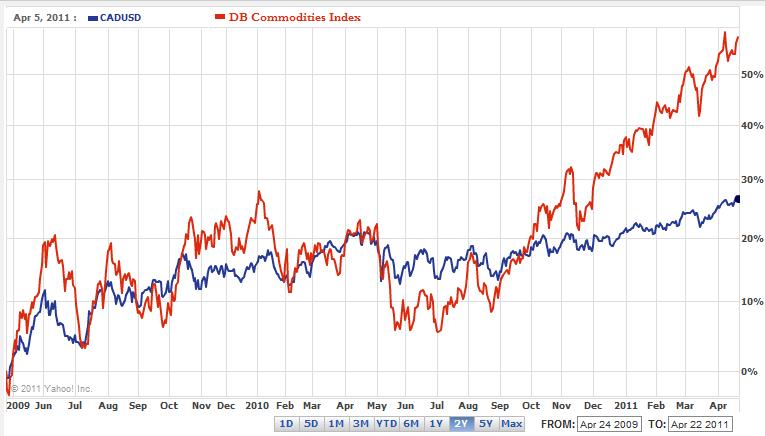
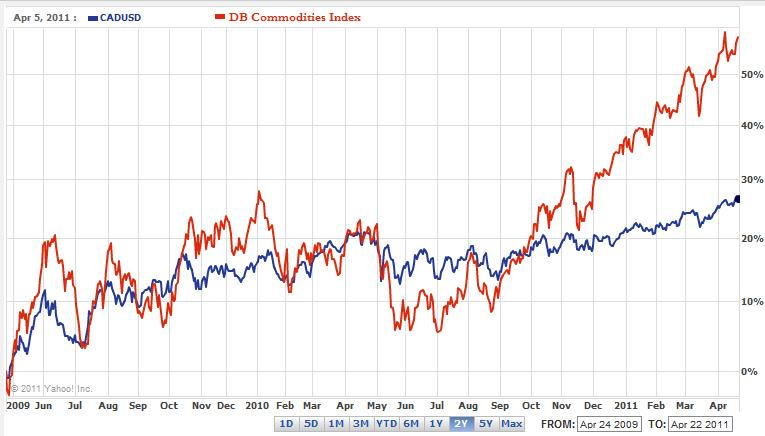
To be sure, the rally in commodities prices has been incredible- nearly 50% in less than a year! Oil prices are surging, gold prices just touched a record high, and a string of natural disasters have driven prices for agricultural staples to stratospheric levels. Given the perception of the Canadian dollar as a commodity currency, then, it’s no wonder that rising commodity prices have translated into a stronger currency.
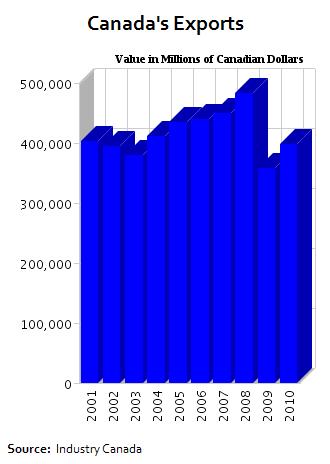
As I’ve argued previously, rising commodities prices are basically an irrelevant – or even distracting – factor when it comes to analyzing the loonie. That’s because, contrary to popular belief, commodities represent an almost negligible component of Canada’s economy. Canadian exports, of which commodities probably account for half, have recovered from the recession lows of 2009. On the other hand, the value of Canadian exports is basically the same as it was 10 years ago, when one US dollar could be exchanged for 1.5 Canadian dollars.
Consider also that Canada now imports more than it exports, and that the Canadian balance of trade recently dipped into deficit for the first time since records started being kept 40 years ago. Its current account has similarly plunged, as Canadians have had to finance this through loans and investment capital from abroad. Based on the expenditure approach to GDP, trade actually detracts from Canadian GDP. Any way you perform the calculations, commodities are hardly the backbone of its economy, account for about 15% at most.
As if that weren’t enough, the press is full of stories of Canadians that think their own currency is overvalued. Businesses complain that they can’t compete, and that banks won’t lend them the money they need to upgrade their facilities and become more efficient. Meanwhile consumers whine about higher prices in Canada, compared to the US. I think it’s very telling that there is now a 2-hour wait to cross the border from Vancouver, and shopping malls on the American side have reported a huge jump in business. Even the famous Big Mac Index shows that the price of a hamburger was already 12% higher in Canada back when the loonie was still hovering around parity with the US Dollar.
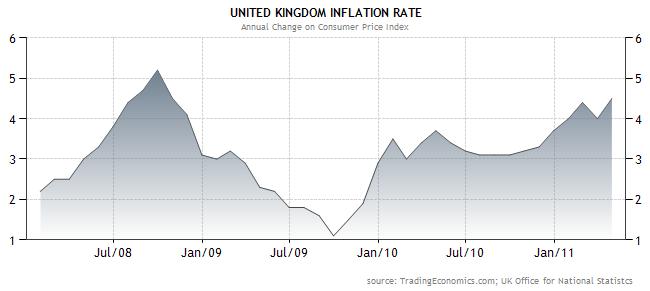
One area that higher commodities prices will be felt is inflation, which is nearing a two-year high and rising. At 3.3%, Canada’s CPI rate is now higher than in the EU. Given that the European Central Bank hiked rates earlier this month, it probably won’t be long before the Bank of Canada follows suit. In fact, forecasters expect the benchmark rate to rise by 50-75 basis points by the end of the year, from the current 1%.
This might excite carry traders, but probably few others. Besides, given that other central banks will probably raise rates concurrently, it can’t be assumed that carry traders will automatically gravitate towards the Canadian dollar. Not to mention that as I pointed out in my previous post, the carry trade is hardly a risk-free proposition. In this case, an interest rate differential of only 1-2% probably isn’t enough to compensate for the risk of a correction in the USD/CAD.
And that is exactly what I expect will happen. The fact that the loonie has shattered even the most optimistic forecasts is not cause for bullishness, but rather for concern. According to the most recent Commitment of Traders report, net long positions are reaching extreme levels, and it’s probably only a matter of time before the loonie returns to earth.

Read more

Currency Correlations, Part II: Canadian Dollar Begins its Decline

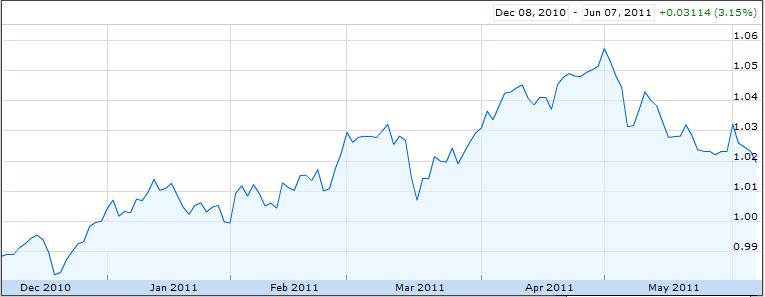
In April, I wrote a post entitled, “Economic Theory Implies Canadian Dollar will Fall,” in which I argued that the currency’s impressive rise was belied by fundamentals. It seems the gods of forex read that post; since then, the Loonie has fallen 3% against the US dollar alone. Based on my reading of the tea leaves, the loonie will fall further over the coming months, and finish the year below parity.

My contention is basically that investors are falsely treating the Loonie is a high-yield growth currency, and hence, bidding up its value. There are a few reasons why I believe this viewpoint is completely erroneous. First of all, Canada’s economy is both plain and mature. While it is indeed rich in natural resources would seem to make it stand-out, commodities exports account for only a small portion of GDP. Given that the US absorbs 75% of its exports, it’s no accident that Canada’s economic fortunes are tied closely to the US. Finally, Canadian interest rates are pretty mediocre, which means there is neither a strong monetary nor an economic impetus for buying the Loonie against the dollar.
While Canadian GDP and inflation have exceeded analysts’ predictions, the consensus expectation is still for the Bank of Canada to hold off on tightening until September or so. Even the most bullish forecasts show a benchmark interest rate of only 1.75% by the end of 2011 and perhaps 3% at the end of 2012. In other words, it will be a long time before the Loonie becomes a viable target currency for the carry trade.
According to OECD models, the Canadian dollar is overvalued by 17% against the Dollar on a purchasing power parity (ppp). While it is generally dubious to apply this concept to currency markets, I think it’s reasonable to invoke it when analyzing the USD/CAD. The two economies share more than just a border. As I said, their economies are closely intertwined, and goods, services (and people!) move freely between the two. Thus, you would expect that large discrepancies in prices should disappear over the medium-term. In fact, the Canadian trade balance recently slipped into deficit for the first time in 40 years (corresponding with the Loonie’s record high level), which shows just how quickly consumers can shift their attention south of the border. That means that either Canadian prices have to decline (something which retailers are always reluctant to effect) or the Loonie must drop further against the Dollar.
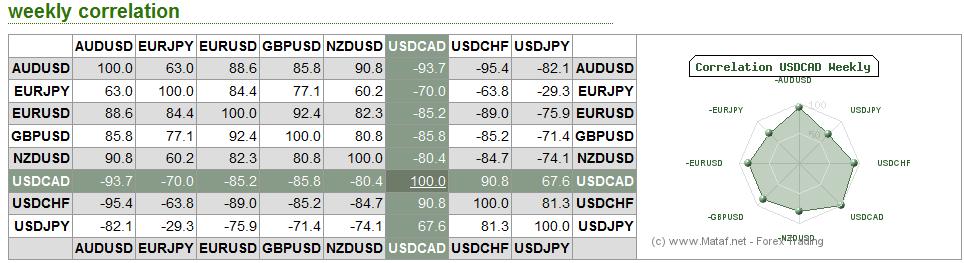
Of course, there is a mitigating factor: the US dollar may fall even faster than the loonie. While it would seem impossible to tease apart the loonie’s rise from the dollar’s fall (since a rise in CADUSD inherently reflects both), we can still make an educated guess. For example, consider that the Canadian dollar is strongly correlated (i.e. greater than 80 or less than -80 in the chart above) with almost every other major currency, relative to the US dollar. If the correlation was low, than it would imply that the Canadian dollar is fluctuating (in this case falling) for endemic reasons. In this case, however, the almost perfect correlation with the majors shows that it is almost definitely a US dollar spike rather than a Canadian dollar correction.
Whether this trend continues then, depends more on the health of the US dollar and less on what investors think about the loonie.

Read more

Is the Chinese Yuan the Most Reliable Forex Trade?

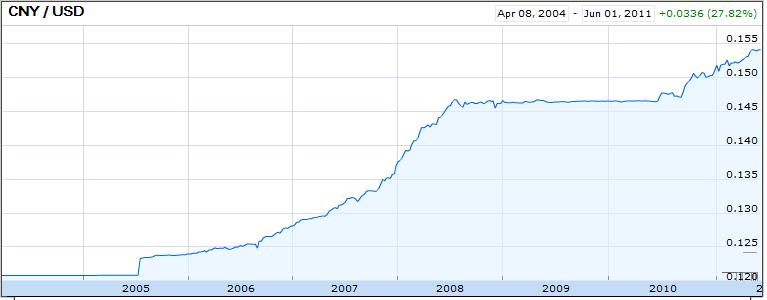
Over the last six years, the appreciation of the Chinese Yuan has been as reliable as a clock. Since 2005, when China tweaked the Yuan-Dollar peg, it has risen by 28%, which works out to 4.5% per year. If you subtract out the two year period from 2008-2010 during which the Yuan was frozen in place, the appreciation has been closer to 7% per year. There is no other currency that I know of whose performance has been so consistently solid, and best of all, risk-free!
As I wrote in an earlier post on the subject, the economic case for further appreciation is actually somewhat flimsy. When you factor in the 5-10% inflation that has eroded the value of the Yuan over the last few years, its appreciation in real terms has more than exceeded the 25-40% that economists and politicians asserted as the margin by which it was undervalued. While prices for many services remain well below western levels, prices for manufactured goods already equal or exceed those that Americans pay. (As a resident of China, I can assure you that this is the case!). Given that Chinese GDP per capita (a proxy for income) is 12 times less than in the US, that means that relative price levels in China are already significantly greater than the US. Thus, further appreciation would only cause further distortion.
Regardless, investors continue to brace for further appreciation, and expectations of 5-6% for the foreseeable future are the norm. Even futures contracts – which typically lag actual appreciation because of their non-deliverable nature – are pricing in higher expectations for appreciation. Perhaps the greatest indication is that 9% of all of the capital pouring into China is so-called “hot-money.” That means that despite the 27% appreciation to date, a substantial portion of investment in China is connected only to the expectation for further Yuan appreciation.
Even though the Yuan is not fully-tradeable, its continued rise has serious implications for forex markets. First of all, there will be follow-on effects for other currencies. Almost every emerging market economy competes directly with China, and all are thus keenly aware that China pegs its currency against the US dollar. By extension, many of these economies feel they have no choice but to intervene daily in forex markets to prevent their respective currencies from appreciating faster than the RMB.
At the very least, the appreciation in Asian and Latin American currencies will keep pace with the Yuan: “This is a long-term secular trend for emerging market currencies especially in Asia. Asian currencies have long been undervalued and they are on a convergence path with the United States and the G7 more broadly and that’s going to lead to an appreciation,” summarized one analyst.
All of this action will cause the dollar to depreciate. The Chinese Yuan alone accounts for 20% of the Federal Reserve Bank’s trade-weighted dollar index, and Asia ex-Japan accounts for another 20%. Regardless of the other G4 currencies perform, that means that a conservative 7% annual appreciation in Asia will drive a minimum 3% annual decline in the trade-weighted value of the dollar. Even worse is that this cause a broad loss of confidence in the dollar, driving the dollar lower across-the board. And this doesn’t even aaccount for the multiplier effect that net exporters will no longer need to indiscriminately accumulate dollar-denominated assets. China, itself, has unloaded part of its massive hoard of US Treasury securities for five consecutive months.
The implications for how long-term investors should position themselves are clear. Unfortunately, while further appreciation in the Chinese Yuan is all but guaranteed, achieving exposure to this appreciation is beyond difficult. Neither of the ETFs that claim to represent the Yuan (CNY, CYB) have budged over the last couple years, and they are a poor substitute for the actual thing. In other words, your only chance for exposure is indirectly via Chinese stocks and bonds, which are far from transparent and an extremely dubious investment. Or you could try opening a Chinese Yuan bank account with the Bank of China (which now has branches in the US), but it’s unclear whether you will be able to capture 100% of gains from the Yuan’s appreciation.
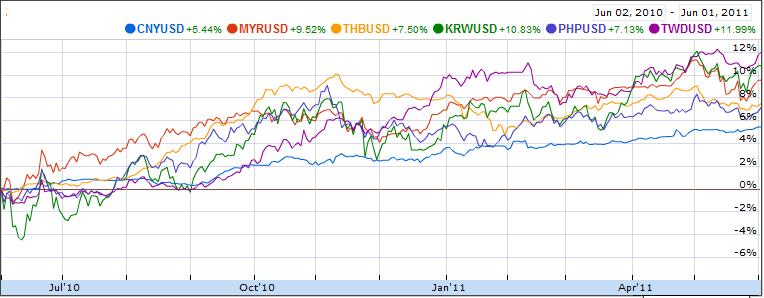
Otherwise, emerging market Asia seems like a pretty good proxy. Of course, you need to be aware that even though the Korean Won, Malaysian Ringgit, Thai Baht, New Taiwan Dollar, Indonesian Rupiah, Philippine Peso, etc. will probably at least match the rise in the Yuan, they are imperfect substitutes for the Yuan, since they are driven more by country-specific factors than by association to China.

Read more

Has the US Dollar Hit Bottom?

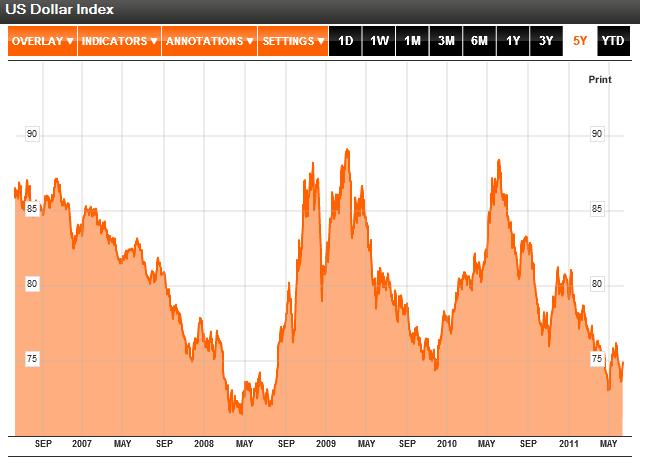
In April, I declared that the dollar would rally when QE2 ended. That date – June 30 – is now only a few weeks away, which means it won’t be long before we know whether I was right. Meanwhile, the dollar is close to pre-credit crisis levels on a composite basis, and has already fallen to record lows against a handful of specific currencies. In other words, it’s now do-or-die for the dollar.

Since my last update, a number of things have happened. Commodity prices have continued to rise, and inflation has ticked up slightly. Meanwhile, GDP growth has moderated, the unemployment rate has stagnated at 9%, and the S&P has fallen slightly as investors brace for the possibility of an economic downturn. Finally, long-term interest rates have fallen, despite concerns that the US will be forced to breach the debt ceiling imposed by Congress.
From the standpoint of fundamentals, there is very little to get excited about when it comes to the dollar. While the US is likely to avoid a double-dip recession (the case for this was most convincingly made by TIME Magazine, of all sources), GDP growth is unlikely to rebound strongly. Exports are growing, but slowly. Businesses are investing (in machines, not people), but they are still holding record amounts of cash. Consumption is strong, but unsustainable. The government will do what it can to keep spending, but given that the deficit is projected at 10% of GDP in 2011 and that Congress is playing hardball with the debt ceiling, it can’t be expected to provide the engine of growth.
Meanwhile, Ben Bernanke, Chairman of the Fed, has implied that QE2 will not be followed by QE3. Still, he warned that “economic conditions are likely to warrant exceptionally low levels for the federal-funds rate for an extended period.” With low growth, high unemployment, and low inflation, there isn’t any impetus to even think about raising interest rates. In fact, Bernanke and his cohorts will continue to do everything in their power to hold down the dollar, if only to provide a boost to exports. Bill Dudley, head of the New York Fed, intimated in a recent speech that the Fed’s current monetary policy is basically a response to emerging market economies’ failure to allow their currencies to rise.
In short, if I was arguing that fundamentals would provide the basis for renewed dollar strength, I would have a pretty weak case. As I wrote a few weeks ago, however, there is a wrinkle to this story, in the form of risk. You see- the dollar continues to derive some significant support from risk-averse investors, as evidenced by the fact that Treasury yields have fallen to record lows.

Ironically, demand for the US dollar is inversely proportional to the strength of US fundamentals. As the US economy has rebounded, investors have become more comfortable about risk, and have responded by unloading safe haven positions in the dollar. With the US recovery faltering, investors are slowly moving back into the dollar, re-establishing safe haven positions. While the dollar faces some competition in this regard from the Franc and the Yen, it still compares favorably with the euro and pound.
In fact, some traders are betting that the dollar’s fortunes may be about to reverse. It has fallen 15% over the last year, en route to a 3-year low. With short positions so high, it would only take a minor crisis to trigger a short squeeze. Said the CEO of the world’s largest forex hedge fund (John Taylor of FX Concepts): “We see a big upside USD catalyst in the next ’3 or 4 days’ on the grounds that…’Our analysis of the markets has shown that they are very, very dangerous.’ ”
For what it’s worth, I also think the dollar is oversold and expect a correction to take hold at some point over the next month.
SocialTwist Tell-a-Friend

Read more

Pound Stagnates, Lacking Direction

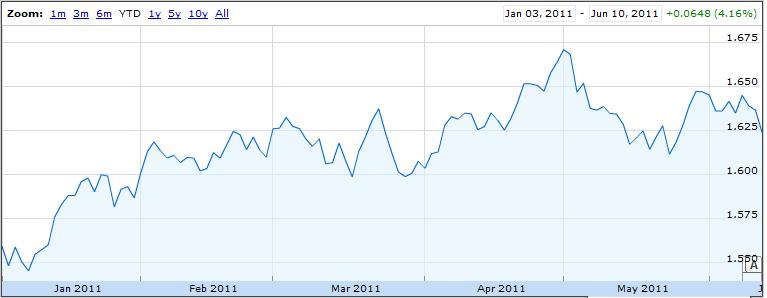
The British Pound has struggled to find direction in 2011. After getting off to a solid start – rising 4% against the US dollar in less than a month -  the Pound has since stagnated. At 1.625 GBP/USD, it is now at the same level that it was at five months ago. Given the paltry state of UK fundamentals, the fact that it still has any gains to hold on to is itself something of a miracle.

The Pound’s failure to make any additional headway shouldn’t come as a surprise. First of all, the Pound is not a safe haven currency. That means that the only chance it has to rise is when risk is “on.” Unfortunately, the Pound also scores pretty low in this regard. Annual GDP growth is currently a pathetic .5%, and is projected at only 1.8% for the entire year. Inflation is high, and both the trade balance and the current account balance are in deficit. Deficit spending has caused a surge in government debt, and there is a possibility that the UK could lose its AAA credit rating.
Investors might be willing to overlook all of this if interest rates were at an attractive level. Alas, at .5%, the Bank of England’s (BOE) benchmark rate is among the lowest in the world. Moreover, it isn’t expected to begin hiking rates for many months, and even then, the pace will be slow. Simply, the economy is too fragile to support a serious tightening of monetary policy. Interest rate futures reflect a consensus expectation that rates will be only 75 basis points higher one year from now.
If that’s the case, why hasn’t the Pound crashed entirely? To be fair, the Pound is losing groroundround against both the euro and the franc, the former of which has it bested in economic grounds while the latter is cashing in on its status as a safe haven currency. On the other hand, the Pound is still up for the year against the US dollar and Japanese Yen, both of which are also safe haven currencies.
It could be the case that the Pound is simply not the ugliest currency, since all of the charges that can be leveled against it can similarly be leveled against the dollar. Head-to-head, it’s actually quite possible that the Pound still wins, if only because its interest rates are slightly higher than the US. Or, it could be the case that investors still believe the BOE will come around and begin hiking rates. After all, at the beginning of the year (when by no coincidence, the Pound was still rising), expectations were that the BOE would have already hiked twice by this time, bringing the benchmark to a level that would make the Pound attractive to carry traders. While the BOE hasn’t followed through, carry traders may be sticking around, since the opportunity cost of holding the Pound is basically nil.
As for whether the Pound correction (that I first observed last month) will continue, that depends entirely on the BOE. Unfortunately, there is very little reason to believe that the UK economy will suddenly pick up, and hence very little reason to expect the BOE to suddenly tighten. At some point, earning .5% interest on Pounds will become unattractive to investors. Until that day comes, that might stick with the Pound out of sheer inertia. While the Pound may hold its value for this reason, I don’t think it has any hope of appreciating further this year.

Read more

S&P 500 Decouples from Euro?

While I have written quite about forex correlations in recent posts, the focus has primarily been on correlations that exist between currencies. In this post, I would like to address a correlation that exists between currencies and other forex markets- specifically the relationship between the Euro and US stocks.

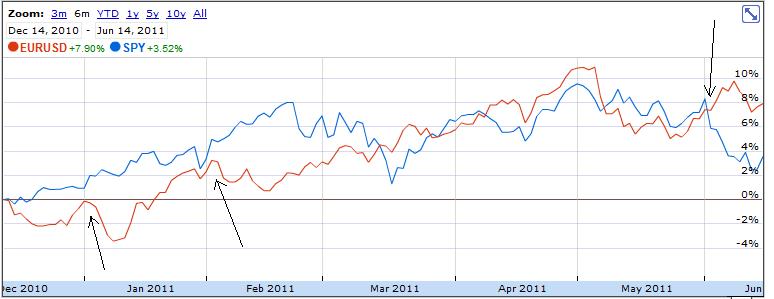
If you look at the chart above, you can see that an unmistakable correlation exists between the S&P500 and the EUR/USD that stretches back at least six months. Generally speaking, when the EURUSD has risen, so has the S&P 500, and vice versa. In fact, this correlation is so airtight that one analyst recently discovered that the two financial vehicles often reach intra-day highs and lows within minutes of one another!
Why is this the case? In a nutshell, it is because the Euro – especially relative to the dollar – is a proxy for risk appetite. The same is necessarily true for US stocks. When investors are confident in the strength of the global economic recovery and the possibility of crisis is distant, the euro will rise. This has nothing to do with fundamentals in Europe, which are probably at least as bad as they are in the US. Of course, it may be connected with dollar weakness, since it is arguably the case that quantitative easing has both depressed the dollar and buoyed US stocks.
As I intimated in the title of this post, however, the S&P recently decoupled from the euro. Since the beginning of June, US equities have declined sharply, to the extent that they have given back most of their gains in the year-to-date. The EUR/USD, meanwhile, continued rising all the way until last week. While this has happened on a couple previous occasions, this was perhaps the sharpest break between the two.
I’m personally at a loss to explain why this happened. It has been conjectured that the driving force behind the correlation is algorithmic trading, and that hence, it must also represent the source of the break. In other words, high-frequency traders – which account for an ever-increasing proportion of forex volume – tweaked their trading algorithms so as not to buy the S&P 500 when the EURUSD rises, and vice versa.
It’s probably also the case that S&P 500 was falling for endogenous reasons- specifically a decline in GDP growth and earnings expectations which need not necessarily reflect itself in a stronger euro. In fact, in a normal functioning market, you would expect an inverse correlation; strong US economic fundamentals should translate into both a strong dollar and rising stocks. Could it be that worsening fundamentals are manifesting themselves in the form of a weak dollar and weak stocks?
Alas, the correlation has re-established itself over the last week, which means this is largely a moot issue. At the very least, it’s still worth being aware of, both insofar as it remains intact and in the event that it breaks down again.

Read more

Euro Nears Breaking Point

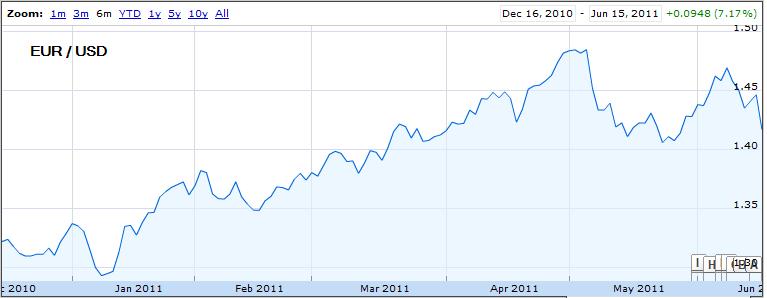
It’s deja vu all over again in the forex markets as another twist in the sovereign debt crisis has sent the euro tumbling by the greatest margin in nearly a year. It was only last month that I posted “The Euro (Still) has a Greek Problem,” and yet, forex markets are once again reacting to the possibility of a Greek default as thought it were a new development. At the very least, investors finally seem to be acknowledging the inevitable.
There have been several factors at work in this latest episode. On Monday, S&P downgraded its credit rating for Greece to CCC, following on a similar move by Moody’s. That means that Greece’s sovereign credit rating is now the lowest in the world, behind such eminent economies as Grenada and Ecuador. While the move was hardly noteworthy in itself, it represents one more straw on the camel’s back.
Greece’s government is increasingly unstable, and Prime Minister George Papandreou has become so desperate that he has suggested forming an alliance with Greece’s most powerful opposition party. Meanwhile, violent riots outside Greek Parliament have reportedly become a daily occurrence, as the Greek populace has proven unwilling to accept wage cuts and tax increases.
As if that weren’t enough, there is tremendous uncertainty surrounding the next stage of the Greek bailout. No one can agree on what amount to give and what should be stipulated in return. Some parties think that private investors should be involved in the bailout by taking a “haircut” on the bonds that they own. Some members of the eurozone are balking about contributing any funds at all, wary of justifying it to their own citizens and that it is merely forestalling the inevitable.
I think the NYTimes offered the best summary: “Funding fatigue is growing in the north European creditor countries, especially Germany, the Netherlands, Finland and Austria, just as austerity fatigue is mounting in Greece.” When you consider that Greek interest rates and credit default swap spreads have surged to record highs, it seems that default is really inevitable. If the IMF and European Union are so determined, they can push off default until 2013. Still, default now or default then is still default.
At this point, then, the only real question is what happens when Greece defaults. Will it be forced to leave the Eurozone? Will that push the rest of the Eurozone fringe closer towards default? Will the Euro collapse and cease to exist as a currency? What will happen then?
Unfortunately, I think the answer to all of these questions is yes. At the very least, Greece will be forced out of the eurozone. Bondholders will push interest rates in Ireland, Spain, and Portugal up to double-digit levels, trapping them in the same cycle in which Greece is currently ensnared. Given the exposure of French and German banks to the sovereign debt of financially troubled eurozone members, they will also require state bailouts, and so on.
In a recent op-ed published in The Financial Times, celebrity economies Nouriel Roubini argued that the only way to avoid a complete eurozone meltdown is if the euro depreciates rapidly “to restore competitiveness to the periphery” or if the European Union is able to rapidly achieve complete fiscal and economic union. Roubini argues that the former is difficult because of the ECB’s hawkishness, while the latter is precluded by political hurdles that remain too formidable to overcome.
As Greece inches ever closer to default, the markets will increasingly become gripped by utter uncertainty over the questions that I posed above. Central Banks will stop accumulating euro-denominated assets, and investment funds will similarly shun Europe. (In fact, there is already evidence that this is happening). While European interest rates are attractive relative to the rest of the G4, they are hardly enough to compensate investors for this uncertainty. And when the markets come to terms with this, the euro might finally reach its breaking point.

Read more